
Introduction
Redwud Creations works exclusively in healthcare. We’ve seen hospitals in Chennai spend significant budgets on digital campaigns that attract clicks but not patients — because the strategy wasn’t built around how healthcare decisions are actually made.
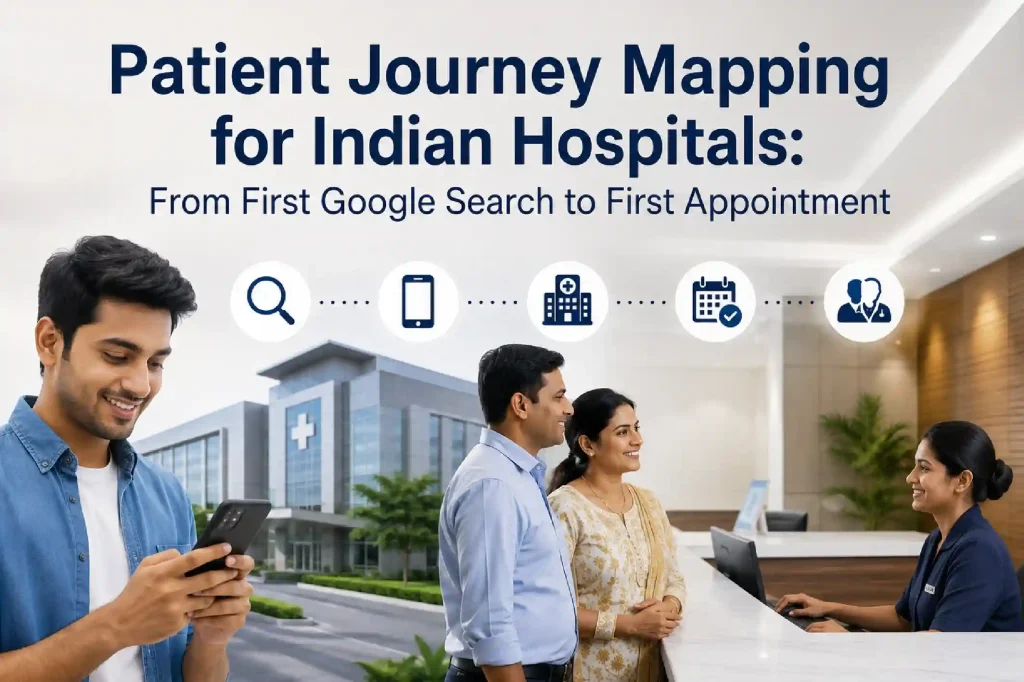
Patient journey mapping India is the process of tracing every step a patient takes — from the first symptom search on Google, through comparing hospitals and doctors, to booking that first appointment. For hospital administrators and clinic owners, this isn’t an abstract marketing exercise. It’s the difference between a website that generates traffic and one that generates patients. This guide breaks down what works, what doesn’t, and what your next move should be, with specific attention to how patients in Chennai and across urban India actually search, compare, and decide.
We’ll cover the current landscape shaping patient decisions in 2026, a practical framework for mapping and optimizing each stage, and how this connects to measurable appointment growth — not just website visits.
Why Patient Decision-Making Has Changed
Healthcare-seeking behaviour in India has shifted faster than most hospital marketing strategies have kept up with. A patient today rarely walks into the nearest hospital. They search symptoms, read about specialists, check Google reviews, compare consultation fees across three or four hospitals, and often ask a WhatsApp group or family member before calling to book.
This shift matters because most hospital websites are still built around the institution, not the decision process. Departments are listed the way the hospital organizes itself internally, not the way a worried patient searching “best cardiologist near me Chennai” actually thinks. The result is high bounce rates on high-intent traffic — patients who searched with real urgency but left because the site didn’t answer their question fast enough.
For a hospital or clinic, this represents both a challenge and an opportunity. The challenge is that patient attention during a health concern is short and anxious; the opportunity is that a well-mapped digital journey converts that anxiety into trust, and trust into a booked appointment. Getting this right directly affects patient acquisition cost, appointment volume, and how much of your marketing budget is actually working instead of just spending.
A Practical Framework for Mapping the Patient Journey
Most competitor content on this topic stops at generic “awareness, consideration, decision” funnel diagrams borrowed from retail marketing. That framework doesn’t hold up in healthcare, where trust, urgency, and clinical credibility change the rules at every stage. Below is a framework built specifically around how Indian patients move from search to appointment.
Stage 1: The Symptom Search This is where the journey begins, often on mobile, often late at night. Patients search symptoms, not hospital names. Your content needs to exist at this stage — symptom-specific pages, condition guides, and doctor-authored explainers that rank for these queries. A hospital with no content answering “why does my chest hurt when I breathe deeply” is invisible at the exact moment a patient is making their first decision.
Stage 2: The Comparison Phase Once a patient has a working idea of what’s wrong, they start comparing providers. This is where Google Business Profile accuracy, review volume and recency, doctor-specific landing pages, and transparent information on consultation fees and wait times matter enormously. Patients in Chennai frequently cross-reference three signals here: Google ratings, a doctor’s listed experience, and whether the hospital’s website loads fast and answers their question without forcing a phone call.
Stage 3: The Trust Verification Before booking, most patients do one more check — they search the specific doctor’s name, look for patient testimonials, or check whether the hospital has been mentioned in credible health content. This is where authoritative, doctor-reviewed content and a genuine online reputation (not manufactured reviews) separate hospitals that convert from hospitals that don’t.
Stage 4: The Booking Decision This is the transactional moment, and it’s where most hospital websites lose patients unnecessarily — through slow-loading appointment forms, unclear next steps, or a lack of WhatsApp or call-back options. Reducing friction here, not adding more marketing messaging, is what moves the needle.
Channel-Specific Tactics Across the Journey
- SEO: Build symptom and condition pages targeting long-tail queries like “how patients choose hospitals in India 2026” alongside doctor and department pages optimized for local search.
- Local SEO: Keep Google Business Profiles updated per department, respond to every review, and ensure NAP (name, address, phone) consistency across directories — critical for Chennai-based multi-branch hospitals.
- Content Marketing: Publish doctor-authored, clinically reviewed articles. This directly supports E-E-A-T signals Google and AI Overviews now weigh heavily for YMYL (Your Money Your Life) healthcare content.
- Paid Advertising: Use Google Ads sparingly at the comparison stage with landing pages matched to specific conditions, not generic hospital homepages.
Compliance and Ethical Considerations
Healthcare marketing in India must respect Medical Council of India (MCI) advertising guidelines, which restrict direct solicitation and prohibit misleading claims about outcomes or doctor credentials. Content should inform, not oversell. For hospitals serving international patients, HIPAA considerations apply specifically to how patient data is handled in that cross-border context — this is distinct from Indian data handling, which follows India’s own regulatory framework and should not be conflated with HIPAA compliance.
Common Mistakes and Metrics to Track
The most common mistake is optimizing for website traffic instead of appointment conversions. Track cost per appointment, not just cost per click. Monitor which content pieces drive actual bookings versus which drive bounce. A hospital receiving 10,000 monthly visitors with 12 appointments has a journey mapping problem, not a traffic problem.
What Hospitals Gain from Journey Mapping
Hospitals that invest in patient journey mapping typically see improved appointment conversion rates because content and website structure finally match how patients actually search and decide. Beyond immediate bookings, this builds a stronger digital reputation over time, as trust-focused content and responsive review management compound month over month.
The competitive differentiation is real in a market like Chennai, where multiple multi-specialty hospitals compete for the same searches. Short-term impact shows up in appointment volume; long-term impact shows up in reduced patient acquisition cost and stronger organic visibility that doesn’t depend entirely on ad spend.
How Redwud Creations Approaches This
Redwud Creations builds patient journey maps specific to each hospital’s specialties, competitive set, and Chennai or regional market position — not generic templates. Our team combines healthcare marketing experience with clinical-content review processes, ensuring every piece of content meets both SEO requirements and medical accuracy standards.
Our methodology starts with a journey audit: analyzing current search visibility at each of the four stages above, identifying where patients are dropping off, and rebuilding content and site structure around actual patient search behaviour rather than internal hospital hierarchy. We use tools including Google Search Console, GA4, and structured data implementation to track patients from first search through booked appointment, not just to a landing page.
What differentiates our approach in the Chennai healthcare marketing space is the refusal to separate marketing performance from clinical trust — every recommendation is checked against MCI guidelines and genuine patient experience, not just ranking potential.
Want to see where your hospital’s digital journey is losing patients? Download our free Patient Journey Audit Checklist to identify gaps across your search, comparison, and booking stages.
Conclusion: Your Next Step
Patient journey mapping isn’t a one-time project — it’s the foundation that determines whether your digital marketing spend produces appointments or just impressions. The hospitals winning in Chennai’s competitive healthcare market are the ones whose content, local SEO, and website experience are built around how patients actually search and decide, not how the hospital is internally organized.
If your current strategy is generating traffic without a proportional rise in appointments, the gap is likely in the journey, not the budget. Book a strategy call with Redwud Creations to map your hospital’s patient journey and identify where you’re losing qualified leads.
FAQ
What is patient journey mapping in healthcare marketing?
Patient journey mapping is the process of tracing every touchpoint a patient experiences, from first symptom search to booked appointment. It helps hospitals identify where potential patients drop off and rebuild content, SEO, and website experience around actual patient decision-making rather than internal hospital structure.
How do patients in India typically choose a hospital in 2026?
Patients typically start with a symptom search, then compare hospitals using Google reviews, doctor credentials, and consultation fees, and finally verify trust through testimonials or doctor-specific searches before booking. Mobile search and WhatsApp consultations increasingly influence this process.
Why do hospital websites get traffic but few appointments?
This usually happens when website content and structure are organized around hospital departments rather than patient search behaviour. High-intent visitors leave when they can’t quickly find answers to their specific concern, resulting in high traffic but low appointment conversion.
What role does local SEO play in the patient journey?
Local SEO ensures a hospital appears in “near me” searches and Google Business Profile results during the comparison stage. Accurate listings, consistent NAP details, and active review management directly influence whether patients shortlist a hospital before booking.
Are there regulations hospitals must follow in healthcare digital marketing in India?
Yes. Healthcare marketing in India must comply with Medical Council of India (MCI) advertising guidelines, which restrict misleading claims and direct solicitation. International patient data handling may also involve HIPAA considerations, separate from India’s domestic data regulations.