
Introduction
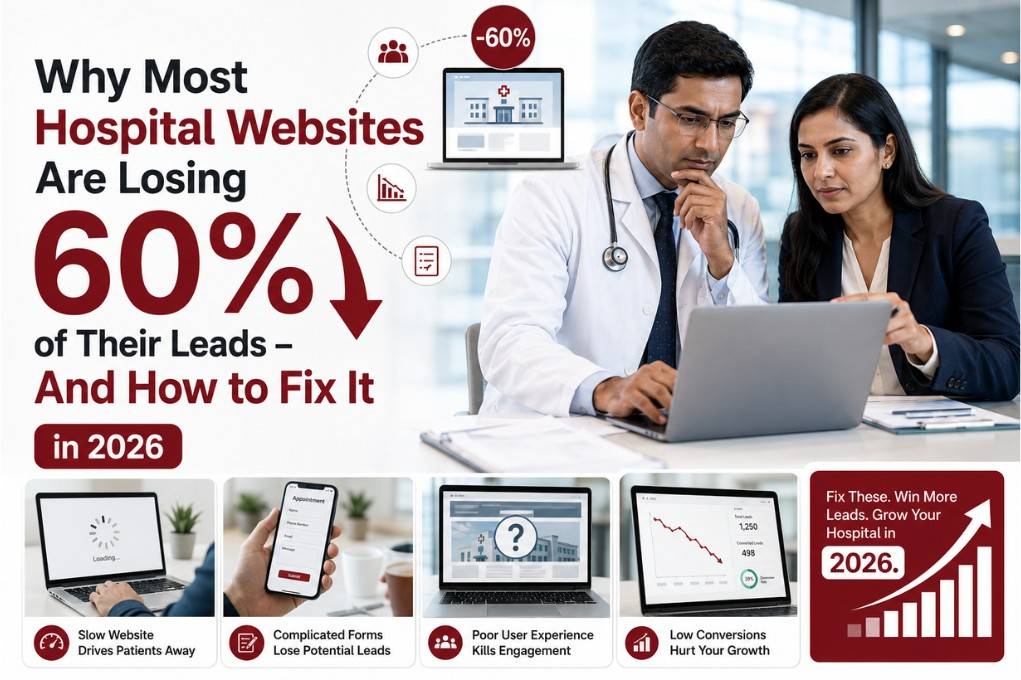
Across Chennai and Tamil Nadu, hospital administrators are spending more on Google Ads, social media, and SEO than ever before — yet their websites aren’t filling appointment slots. The problem isn’t the traffic. It’s what happens after a patient lands on the page.
Hospital website lead generation in India has a conversion problem, and most hospitals don’t realise it until they dig into their analytics. This article will help you diagnose exactly why your website is leaking leads, what structural and behavioural fixes actually work in 2026, and what a realistic improvement plan looks like — without the agency fluff.
Why Hospital Websites Fail at Converting Visitors
Most hospital websites fail at lead conversion not because of poor design, but because they were built for the hospital — not for the patient making a decision at 10pm on a mobile phone.
In Chennai’s competitive multi-speciality hospital market, a pattern repeats itself consistently. A hospital invests in a well-designed website, drives paid traffic to it, and watches enquiry volumes flatline. When you audit these sites, the problems are almost always the same: no clear next step above the fold, contact forms with too many fields, and landing pages that lead to a generic homepage rather than a condition-specific page.
A growing share of patients in Chennai’s metro corridors — and increasingly in tier-2 towns like Vellore, Madurai, and Coimbatore — now begin their hospital search on mobile. If your page takes more than three seconds to load or buries your phone number below the fold, you’ve already lost a significant portion of those visitors.
The issue isn’t awareness. It’s friction. And friction is fixable.
Three Fixes That Directly Improve Hospital Website Conversions
1. Rebuild Your Landing Pages Around Patient Intent — Not Specialties
Most hospital websites are structured around departments: Cardiology, Orthopaedics, Neurology. That’s internal logic — not patient logic. A patient searching “best knee replacement hospital Chennai” isn’t thinking in departments. They’re thinking about their problem.
Condition-specific landing pages — built around what patients actually search — outperform generic specialty pages consistently. Each page should answer four questions immediately:
What’s the problem you treat?
Who are your doctors?
What does the process look like?
What should I do next?
The measurable outcome: Track form submissions and call clicks per landing page. If a page gets traffic but no conversions, it’s a content and UX problem — not a traffic problem.
2. Simplify Your Appointment Journey — Radically
A five-field contact form is not a conversion tool. It’s an exit trigger. In healthcare, patients are already anxious. Every additional field adds hesitation.
The best-performing hospital websites in the Indian market use a two-step appointment flow: one field (phone number) on the first screen, followed by a WhatsApp redirect or a callback confirmation. This fits the digital behaviour of patients across both urban Chennai and semi-urban Tamil Nadu — WhatsApp is familiar, trusted, and immediate.
Measure drop-off rates at each step of your appointment journey. That data tells you exactly where patients are walking away.
Note: If your hospital uses any form of WhatsApp automation for appointment follow-ups, ensure your patient data handling complies with the DPDP Act 2023. This includes obtaining explicit consent before storing or processing any personal health information shared through digital channels.
3. Fix Your Mobile Experience — Specifically for Healthcare UX
Healthcare website conversion in India lives or dies on mobile performance. This isn’t general digital advice — it’s specific to how patients in this market behave. A patient comparing two hospitals will make that comparison on a phone, often in a low-bandwidth environment.
Run a Core Web Vitals audit on your hospital website today. Pay specific attention to Largest Contentful Paint (LCP) and Cumulative Layout Shift (CLS). These aren’t just technical metrics — they directly affect whether a patient stays on your page or leaves.
For medical website UX, the non-negotiables are: visible phone number on every page, click-to-call on mobile, and a sticky appointment button that doesn’t disappear when a patient scrolls.
Outcome to track: mobile bounce rate and mobile conversion rate separately from desktop. Most hospitals don’t segment this — and miss the real problem as a result.
What Most Hospitals Get Wrong
The most common mistake is treating the website as a one-time project rather than a conversion asset that needs ongoing attention.
A hospital in Chennai’s southern corridors once approached us after spending heavily on Google Ads for six months with almost no return. The traffic was there. The issue was that every ad was pointing to the homepage — a page with no specific offer, no clear CTA, and a contact form that hadn’t been tested in over a year and was silently failing.
The second mistake is investing in hospital landing page optimisation without fixing the follow-up process. A patient who fills a form and receives no response within two hours in a competitive market will book with someone else. Lead generation without lead management is a waste of budget.
FAQ
Why is my hospital website getting traffic but no enquiries?
Traffic without conversions almost always points to a UX or relevance problem. Your landing pages may not match what patients searched for, your call-to-action may be unclear, or your appointment process may have too many steps. A focused conversion audit will surface the specific issue.
How long does it take to improve hospital website lead generation in India?
Technical fixes — page speed, mobile UX, form simplification — can show measurable improvement within four to six weeks. Content and SEO-led improvements typically take three to six months to stabilise. Healthcare has longer decision cycles than e-commerce; realistic timelines matter.
Does the DPDP Act 2023 affect how hospitals collect leads online?
Yes. Any patient data collected through digital forms, WhatsApp, or chatbots must comply with the Digital Personal Data Protection Act 2023. This includes clear consent language, defined data retention policies, and secure storage. This applies to lead forms, not just clinical records.
What is the most important page on a hospital website for lead generation?
Condition-specific landing pages and the appointment/contact page. Your homepage is for orientation — these pages are where decisions happen. If these aren’t optimised for conversion, your entire digital spend is underperforming.
Conclusion
The single most important insight here: hospital website lead generation in India fails at the conversion stage — not the traffic stage. Most hospitals are paying to bring patients to a door that doesn’t open properly.
Fix the landing page structure. Simplify the appointment journey. Audit the mobile experience. These three changes, done properly, will move the needle more than any additional ad spend.
If you’re unsure where your website is losing patients, Redwud Creations — based in Chennai — offers a free website audit for hospitals and clinics. No pitch. Just a clear picture of what’s working and what isn’t.