Introduction
Hospital marketing budgets across India are under pressure. Administrators in Chennai are spending more on paid search, yet appointment volumes aren’t growing proportionally. The problem isn’t always spend — it’s how efficiently that spend is working once a patient shows interest.
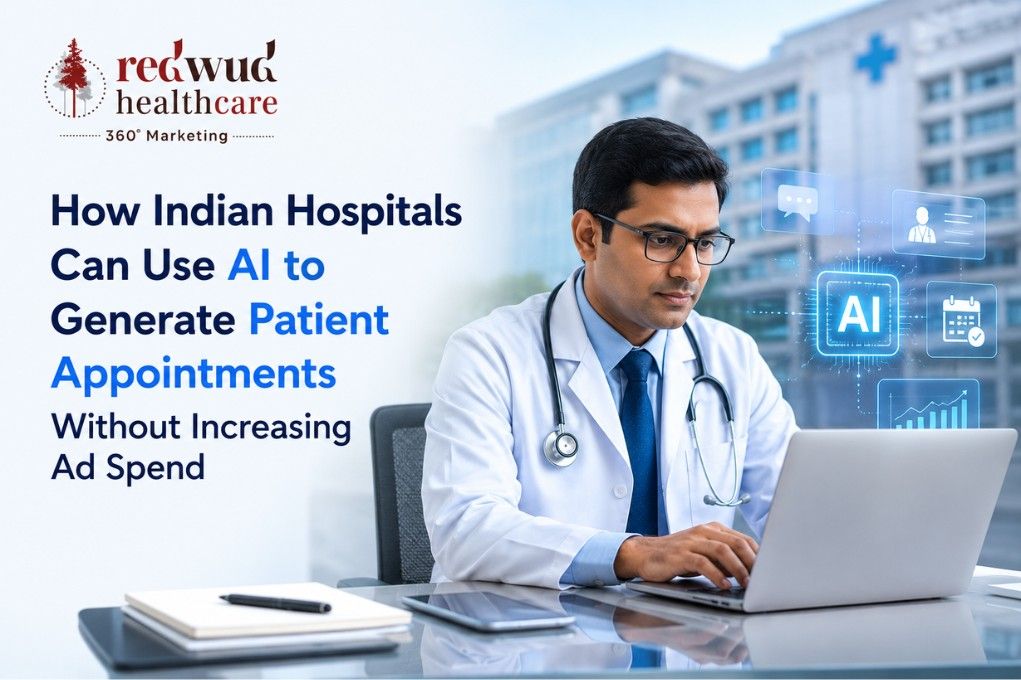
AI patient appointment generation in India is no longer a future concept. It’s being deployed right now — in chatbots, WhatsApp automation, and predictive targeting — by hospitals that want more from their existing digital infrastructure without simply pouring more money into ads.
This article will show you exactly where AI is delivering real results in Indian healthcare marketing, which three applications are worth your attention, and what mistakes to avoid before you invest.
The Real State of AI Adoption in Indian Healthcare Marketing
AI in Indian hospital marketing is being used meaningfully in a narrow set of applications — and overhyped everywhere else. The honest picture is this: most hospitals are still in early adoption, and the gap between what vendors promise and what actually gets implemented is wide.
Where AI is genuinely working right now: appointment follow-up automation via WhatsApp, basic chatbot triage on hospital websites, and content personalisation for condition-specific campaigns. These aren’t glamorous applications, but they directly affect patient acquisition at a measurable level.
Where it’s being overhyped: predictive diagnosis marketing, fully autonomous patient journeys, and AI-generated “personalised” health content at scale. These require data infrastructure that most Indian hospitals — including well-funded multi-speciality chains in Chennai — don’t yet have in place.
A pattern seen consistently across Tamil Nadu’s mid-size hospital market: administrators are sold AI marketing platforms that require clean CRM data to function. Most hospitals don’t have that data structured properly. The AI sits idle, or worse, sends irrelevant follow-ups that erode patient trust.
The trend is directionally clear — AI adoption in healthcare marketing is accelerating. But adoption without readiness assessment produces expensive failures, not appointment growth.
Three AI Applications That Actually Generate Hospital Appointments
1. WhatsApp Automation for Appointment Follow-Up and Re-Engagement
WhatsApp automation is the highest-ROI AI application available to Indian hospitals right now. It works because WhatsApp is where patients already are — across urban Chennai and semi-urban Tamil Nadu alike.
Here’s how a hospital in Chennai’s southern corridor would use it practically: a patient enquires via the website contact form. An automated WhatsApp message goes out within two minutes — not a generic “thank you,” but a message that names the department they enquired about, offers two time slots, and includes a direct booking link. No human intervention required at this stage.
The outcome to measure is response-to-booking conversion rate. If a hospital is converting less than a third of enquiries into confirmed appointments, the follow-up process is the problem — not the lead volume.
Compliance note: any patient data used in WhatsApp automation — phone numbers, health enquiry details, appointment history — must be handled in accordance with the DPDP Act 2023. Explicit consent must be obtained before initiating automated messaging. This applies even to re-engagement sequences for lapsed patients.
2. AI-Driven Local SEO for Clinic and Specialty Discovery
A growing share of patients in Chennai’s metro corridors begin their hospital search on mobile with hyper-local intent — “cardiologist near Velachery” or “best ortho hospital Anna Nagar.” AI tools that analyse local search patterns and automatically optimise Google Business Profile content, review responses, and location-specific landing pages are now accessible to mid-size hospitals without large marketing teams.
For a Chennai hospital with multiple branches, this means each location’s digital presence is optimised individually — not managed as one generic entity. The outcome to measure is local search visibility rank and direction-click-to-appointment conversion per branch.
This is automated patient acquisition in a practical form. It doesn’t replace your marketing team — it removes the repetitive optimisation tasks that typically don’t get done.
3. Predictive Content Targeting for Chronic Disease Programmes
Hospitals running chronic disease management programmes — diabetic care, cardiac rehabilitation, oncology follow-ups — have a patient retention opportunity that most aren’t using effectively. AI tools that analyse engagement patterns (which content a patient viewed, which emails they opened, what they searched) can help serve the right educational content at the right point in a patient’s decision journey.
For example, a hospital running a diabetes management programme in Tamil Nadu could use predictive targeting to identify patients in the awareness stage and serve them condition-specific content, then shift to appointment-focused messaging once engagement signals suggest readiness.
This is not the same as performance marketing — it sits in brand marketing territory and works on longer timelines. Healthcare has longer decision cycles than e-commerce, and this application reflects that reality. Measure it over quarters, not weeks.
All patient engagement data used here falls under the DPDP Act 2023. Consent, data minimisation, and storage limitation principles apply.
What Most Healthcare Providers Get Wrong With AI Marketing
The most common mistake is deploying AI tools before fixing the underlying process they’re meant to automate.
A mid-size hospital in Chennai once implemented a chatbot to handle appointment requests — a reasonable decision. But the chatbot was connected to a booking system that the front desk team didn’t consistently update. Patients booked slots that weren’t actually available. The AI worked. The process behind it didn’t. The result was patient frustration and a loss of trust that took months to recover.
The second mistake is measuring AI marketing on the same timelines as paid advertising. A Google Ads campaign can show results in two weeks. AI-driven content targeting and local SEO automation take three to six months to demonstrate meaningful movement. Hospitals that evaluate AI ROI at the four-week mark will always conclude it doesn’t work — because they haven’t given it the time that healthcare decision cycles require.
FAQ
Can AI really generate hospital appointments without increasing ad spend?
Yes — but through efficiency gains, not magic. AI reduces the time between a patient’s first enquiry and their confirmed appointment, improves follow-up consistency, and surfaces the hospital to more local searchers organically. These gains compound over time without requiring additional paid media budget.
Is AI marketing for hospitals compliant with Indian regulations?
It can be, if implemented correctly. Any use of patient data in AI marketing must comply with the DPDP Act 2023, which requires explicit consent, defined data usage, and secure handling. MCI advertising guidelines also apply — no superlatives about treatment outcomes, no unverified clinical claims.
How long before AI tools show results in hospital marketing?
Expect meaningful results in three to six months for SEO and content applications, and faster — sometimes within weeks — for WhatsApp automation and appointment follow-up tools. Healthcare has longer decision cycles than other sectors. Set expectations accordingly.
What's the first AI application a hospital should implement?
WhatsApp appointment follow-up automation delivers the fastest return with the lowest implementation complexity. Start there, get the consent and compliance framework right, and build from that foundation.
Conclusion
The core insight in this article is straightforward: most Indian hospitals don’t need more ad spend — they need better conversion and follow-up infrastructure. AI marketing for hospitals works best when it removes friction between a patient’s first interest and their confirmed appointment.
Start with WhatsApp automation. Layer in local SEO optimisation. Build toward predictive content targeting as your data matures.
If you want to understand which of these applies to your hospital first, Redwud Creations — based in Chennai — works specifically with Indian healthcare providers on practical AI marketing implementation. Talk to our team to see how this can work for your hospital.