Introduction
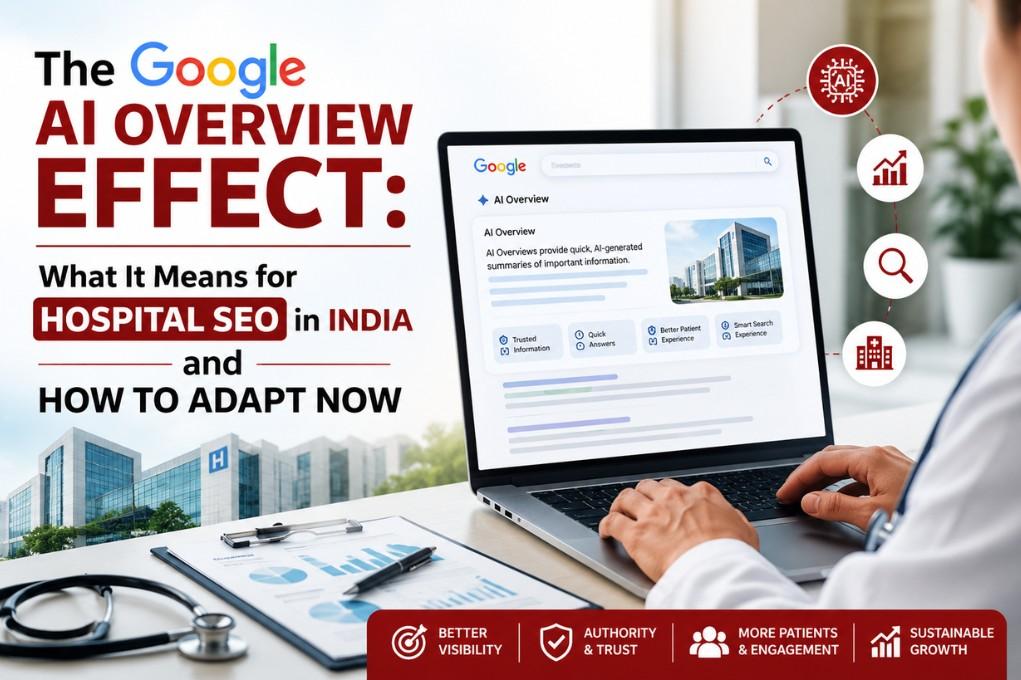
Hospital marketing teams across Chennai are noticing something uncomfortable: organic traffic is declining even when their rankings haven’t changed. The reason, in most cases, is Google AI Overviews — the AI-generated answer blocks that now appear above traditional search results for a wide range of health-related queries.
Google AI Overview healthcare SEO in India is not a future concern. It is already reshaping how patients find hospitals, which content gets cited, and which websites get the click. This article will help you understand what’s actually changing, what it means for your hospital’s search visibility, and three concrete steps you can take right now to stay relevant in an AI-first search environment.
What Google AI Overviews Are Actually Doing to Hospital Search Visibility
Google AI Overviews are reducing the number of clicks that reach hospital websites from informational health queries — and the effect is measurable across India’s healthcare market. When a patient searches “symptoms of kidney stones” or “what to expect after knee replacement surgery,” Google now answers that question directly in the search results. The patient gets what they need without visiting any website.
This is called zero-click search, and it disproportionately affects hospitals that relied on informational content — condition explainers, procedure guides, symptom checkers — to drive organic traffic. That traffic is shrinking, and in many cases it will not return.
In Chennai, where competition among multi-speciality hospitals for high-intent search queries is already intense, this shift is being felt earliest. Hospitals that ranked well for queries like “best cardiac care Chennai” or “diabetic foot treatment Tamil Nadu” are seeing their click-through rates decline even when their position on the results page hasn’t moved.
The directional reality is this: AI search is not replacing SEO — it is restructuring it. Content that answers questions clearly and authoritatively is now more likely to be cited inside an AI Overview than to receive a direct click. Your goal shifts from ranking to being cited. That requires a different content strategy.
Three Ways to Adapt Your Hospital SEO Strategy for AI Search
1. Restructure Content to Be Citation-Worthy for AI Overviews
AI Overviews extract answers from content that is structured clearly, answers a question directly in the opening sentences, and comes from a source Google considers authoritative. This is Generative Engine Optimisation — GEO for hospitals — and it starts with how your content is written, not just how it ranks.
For a hospital in Chennai, this means revisiting every condition and procedure page. Each page should open with a direct, two-to-three sentence answer to the question a patient would ask. Not a general introduction to the department — a specific answer. “Coronary artery bypass surgery is a procedure that reroutes blood flow around a blocked artery in the heart. Recovery typically takes six to twelve weeks, depending on the patient’s overall health.”
The outcome to measure is AI Overview citation rate — whether your hospital’s content is appearing as a source inside Google’s AI-generated answer blocks. This requires manual monitoring and, increasingly, specialised tools that track GEO visibility separately from traditional rank tracking.
2. Build Authoritative Doctor and Department Profile Pages
AI search systems favour content that demonstrates clear expertise and authorship. A generic “Our Cardiology Department” page with a stock image and three paragraphs does not signal authority. A detailed profile of the department head — qualifications, areas of focus, published work, patient education content authored by them — does.
This is Answer Engine Optimisation in practice. For hospitals in Tamil Nadu with strong specialist teams, this is an underused asset. A senior nephrologist at a hospital in Coimbatore or a robotics surgery specialist in Chennai carries genuine authority signals that AI systems can parse and cite.
Implement structured data markup — specifically, MedicalOrganization and Physician schema — on all doctor and department pages. This is how AI systems identify and extract credible healthcare information. Without it, even well-written content is harder for AI to classify correctly.
Compliance note: any personalised content or patient testimonials used on these pages must respect MCI advertising guidelines. No unverified claims about treatment success rates. No patient outcome comparisons. The content must educate — not advertise.
3. Create FAQ-Structured Content That Maps to Real Patient Questions
FAQ sections are now among the highest-value content formats for AI search visibility. Google’s AI Overviews regularly extract FAQ-style content — a specific question followed by a concise, accurate answer — as citation blocks. FAQPage schema markup makes this extraction easier and more consistent.
For a hospital targeting patients across Tamil Nadu — including semi-urban patients who search in simpler, more direct language — this means writing FAQs that reflect how patients actually phrase their questions, not how clinicians think about them. “How long will I stay in hospital after gallbladder surgery?” performs better than “Post-cholecystectomy inpatient duration.”
Map your FAQ content to the actual queries your hospital receives through its helpline, WhatsApp enquiries, and website chat. That data tells you exactly what patients are asking — and what AI systems will be asked to answer on your behalf.
If patient enquiry data is used to inform content strategy, ensure it is handled in compliance with the DPDP Act 2023. Patient communications, even at the enquiry stage, constitute personal data and must be processed with appropriate consent and data minimisation practices in place.
What Most Hospitals Get Wrong When Responding to AI Search Changes
The most common mistake is treating AI Overview optimisation as a technical fix — adding schema markup and hoping for citation. Schema helps, but it is not sufficient on its own. The underlying content must be genuinely useful and clearly structured. Markup applied to thin or vague content produces no improvement.
A hospital group managing multiple locations across Tamil Nadu invested in schema implementation across their entire website — a reasonable step. But their condition pages were written years earlier, opened with department history rather than patient answers, and hadn’t been updated since. The schema had nothing solid to work with. Citations didn’t materialise.
The second mistake is abandoning SEO fundamentals in pursuit of AI visibility. Traditional search results still exist alongside AI Overviews. Hospitals that stop building backlinks, neglect page speed, or let their Google Business Profiles go stale will lose ground on both fronts simultaneously. GEO and AEO complement traditional SEO — they don’t replace it.
FAQ
How do Google AI Overviews affect hospital website traffic in India?
AI Overviews answer informational queries directly in the search results, reducing the number of patients who click through to a hospital website. Hospitals that relied heavily on informational content for organic traffic are seeing the steepest declines. The adaptation required is a shift from ranking for clicks to being cited as a source inside AI-generated answers.
What is GEO and how does it apply to healthcare providers?
Generative Engine Optimisation — GEO — is the practice of structuring content so that AI search systems extract and cite it in their responses. For hospitals, this means writing content that opens with direct answers, uses structured data markup, and demonstrates clear authorship and expertise. It works alongside traditional SEO, not instead of it.
Can a mid-size hospital in India realistically appear in Google AI Overviews?
Yes — citation in AI Overviews is driven by content quality and structure, not just domain authority. A well-structured FAQ page from a Chennai clinic can be cited ahead of a large hospital chain if it answers the question more clearly. The barrier is content quality, not budget.
How long does it take to see results from GEO content changes?
Expect three to six months before AI citation patterns shift meaningfully in response to content updates. This is consistent with broader healthcare SEO timelines. Changes made today will compound over the coming quarters — but this is not a short-cycle tactic.
Conclusion
The single most important takeaway from this piece: AI Overviews are not erasing hospital SEO — they are raising the bar for what useful, trustworthy content looks like. Hospitals that respond by writing clearer, more structured, and more authoritative content will gain citation visibility even as traditional click-through rates decline.
The adaptation is available to every hospital willing to treat its content as a clinical communication asset — not just an SEO box to tick.
If you want to know where your hospital stands in AI search right now, Redwud Creations — based in Chennai — offers an AI search readiness audit built specifically for healthcare providers. Get in touch to take the first step.