
Introduction
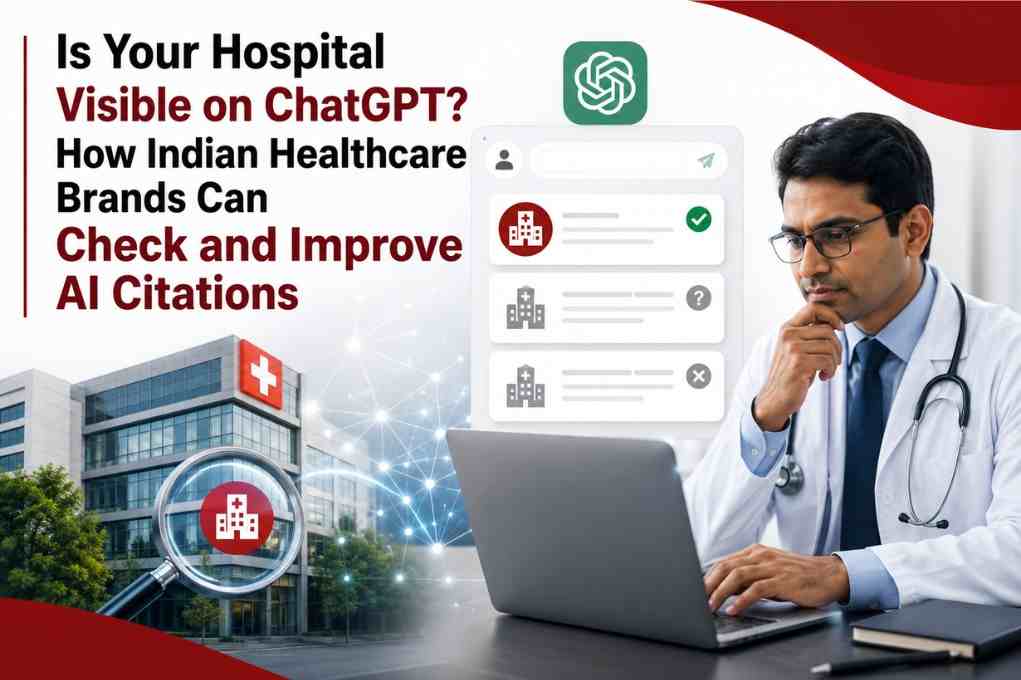
Here’s a quick exercise worth trying before you read any further: open ChatGPT and ask it something like “which hospital in [your city] is best for [a specialty your hospital is known for].” Read the answer carefully. Is your hospital mentioned? Is the information about it accurate? Or does the answer name your competitors instead, while you’re nowhere in the response?
This single test reveals something that most hospital marketing dashboards don’t currently track: hospital ChatGPT visibility in India. Patients are already using AI assistants to shortlist hospitals, compare specialties, and form first impressions — often before they ever visit a website or call for an appointment. Whether your hospital shows up accurately in these answers is no longer a hypothetical future concern; it’s something you can check right now, and something you can actively improve. This guide walks through exactly how to do both.
What "AI Citation" Actually Means for a Hospital
An AI citation happens when a generative AI tool — ChatGPT, Gemini, Copilot, or Perplexity — references, names, or recommends your hospital in response to a user’s question, without the user ever needing to visit your website first. This is different from a traditional search engine ranking, where a link to your site appears in a results list that the user still has to click.
For a hospital, AI citations can take several forms:
- Being named directly as a recommended hospital for a specialty (e.g., “For cardiac care in Chennai, hospitals such as X and Y are often mentioned”)
- Being referenced when a user asks about a specific doctor, procedure, or treatment your hospital offers
- Having your hospital’s general information (location, specialties, accreditation) surfaced accurately when a user asks about hospitals in your area
- Being used as a source the AI draws from, even if not named explicitly, when synthesizing an answer about a health topic you’ve written about extensively
The absence of any of these — your hospital simply never coming up, or coming up with inaccurate information — is the visibility gap this article is about closing.
Why ChatGPT Visibility Specifically Matters
ChatGPT is singled out here for a practical reason: it remains one of the most widely used AI assistants globally and in India, and it’s increasingly a first stop for people researching healthcare decisions, from understanding a diagnosis to shortlisting hospitals and doctors. While Gemini, Copilot, and Perplexity all matter for a complete AI visibility strategy, ChatGPT’s scale and its integration into everyday search behavior make it a reasonable, high-impact starting point for hospitals just beginning to assess their AI presence.
That said, the practices that improve ChatGPT visibility largely overlap with what improves visibility across other AI platforms — so this isn’t a narrow, single-platform exercise. It’s a useful lens into a broader question.
How to Check If Your Hospital Currently Shows Up
Before making any changes, it’s worth establishing a clear baseline. Here’s a practical way to do that:
- List the questions patients actually ask. Think in terms of real patient language — “best hospital for knee replacement in [city],” “which hospital treats [condition] near me,” “top cardiologist in [city]” — rather than your own internal marketing terms.
- Ask these questions directly in ChatGPT (and ideally Gemini, Copilot, and Perplexity too), noting whether your hospital appears, how it’s described, and whether the information given is accurate.
- Ask about your hospital by name. Questions like “what is [Hospital Name] known for” or “tell me about [Hospital Name] in [city]” reveal what the AI already “knows” and whether it’s accurate or outdated.
- Check for competitor comparisons. Ask the AI to compare hospitals in your specialty or city, and note where your hospital ranks in that response, if at all.
- Document what you find. Screenshot or record the responses, since this becomes your baseline for measuring improvement over time.
This process typically takes less than an hour and is often the moment hospital leadership first sees, concretely, whether this is a real gap for their brand — rather than a theoretical one.
What It Means If Your Hospital Doesn't Appear
If your hospital doesn’t come up — or comes up with outdated, incomplete, or inaccurate information — it doesn’t necessarily reflect the quality of care you provide. More often, it reflects the state of your hospital’s digital content: how clearly it’s structured, how consistently your information appears across the web, and how much genuinely in-depth content exists about your specialties.
This is worth sitting with as a leadership team, because the implication is significant: a patient using AI to shortlist hospitals for a serious diagnosis may never encounter your hospital as an option, regardless of your actual clinical strength in that area. This is a content and structure problem, and importantly, it’s a solvable one.
Why Some Hospitals Get Cited and Others Don't
Across hospitals that do show up well in AI answers versus those that don’t, a few consistent differences tend to stand out:
- Depth of topical content — hospitals with genuinely comprehensive content on a specialty (not just a single overview page) are more likely to be treated as a credible source on that topic.
- Clarity of information — content that answers questions directly and plainly, rather than burying the actual information under marketing language, is easier for AI systems to extract accurately.
- Consistency across the web — hospitals whose name, address, specialties, and doctor details are consistent across their website, Google Business Profile, and medical directories tend to be represented more reliably.
- Structured data — the presence of schema markup (Organization, LocalBusiness, MedicalWebPage, FAQPage) gives AI systems clearer signals about what a page represents.
- External validation — mentions and consistent information across independent, credible sources reinforce the trust signals AI systems draw on when deciding what to cite.
Hospitals that show up well in AI answers are rarely doing one thing exceptionally — they’re usually consistent across all of these factors at once.
The AI Citation Checklist for Hospitals
Use this checklist as a practical starting point for your own audit:
- Have you tested how your hospital appears across ChatGPT, Gemini, Copilot, and Perplexity for relevant patient questions?
- Does your website have in-depth, dedicated content for each major specialty, beyond a single summary page?
- Are your hospital’s name, address, phone number, and specialties identical across your website, Google Business Profile, and third-party medical directories?
- Do your key pages include schema markup (Organization, LocalBusiness, MedicalWebPage, FAQPage)?
- Do your FAQ sections use the actual language and phrasing patients search with, answered directly and concisely?
- Are your doctor profile pages detailed, accurate, and structured with clear credentials and specialties?
- Is your hospital accurately listed on recognized healthcare directories and review platforms?
- Do you have a process for periodically re-checking your AI visibility, rather than treating this as a one-time exercise?
A hospital that can check most of these boxes is generally in a strong position for AI visibility. Gaps in several areas point to where an improvement effort should start.
Common Mistakes That Keep Hospitals Invisible
A few recurring patterns tend to explain why otherwise reputable hospitals are absent from AI answers:
- Thin specialty pages that list services in a single sentence without the depth AI systems look for when establishing topical authority
- Inconsistent listings — a slightly different hospital name, an outdated address, or mismatched specialty descriptions across different platforms
- No schema markup at all, leaving AI systems to infer page content without clear structural signals
- Marketing-heavy language that makes it harder for AI systems to extract a direct, factual answer from the content
- Treating this as a one-time fix rather than an ongoing practice, which means visibility gained today can quietly erode as AI models and content standards evolve
None of these are difficult to fix individually — the challenge is usually that no one on the team has been tracking them together as a connected visibility issue.
How Long Improving AI Citations Actually Takes
It’s worth setting realistic expectations here rather than promising quick results. Improving AI citation presence typically follows a similar pattern to building traditional search authority: it depends on the depth and consistency of the changes made, and it builds over a sustained period rather than appearing overnight. Foundational fixes — like correcting inconsistent listings or adding schema markup — can show measurable improvement in AI visibility checks within a matter of weeks. Deeper improvements, like building genuinely comprehensive specialty content and external credibility, tend to compound gradually over months.
The hospitals that benefit most are generally the ones that start early and stay consistent, rather than those looking for a single fast fix.
Turning This Into an Ongoing Practice, Not a One-Time Check
Because AI models are updated regularly and continue to change how they source and weight information, a single audit — however thorough — has a limited shelf life. The hospitals that maintain strong AI visibility over time tend to build it into an ongoing practice:
- Periodic AI visibility checks (quarterly is a reasonable starting cadence) across major platforms
- Regular content audits to ensure specialty pages remain comprehensive and accurate
- Ongoing monitoring of listing consistency across the web as directories and platforms change
- Ongoing FAQ and content updates that reflect the way patients are actually asking questions today
Treating this the same way you’d treat any core marketing function — with regular review rather than a single project — is what separates hospitals with durable AI visibility from those with a brief, temporary improvement.
FAQ
How do I check if my hospital shows up on ChatGPT?
Ask ChatGPT direct patient-style questions relevant to your specialties and location (for example, “best hospital for [specialty] in [city]”), and also ask about your hospital by name to see what information it currently has. Document the responses to establish a baseline.
Why doesn't my hospital appear in AI search answers even though we rank well on Google?
Traditional Google rankings and AI citation are related but not identical. AI systems weigh content clarity, structure, schema markup, and consistency across the web more heavily than ranking position alone, so strong SEO doesn’t automatically guarantee AI visibility.
What is an AI citation checklist for hospitals?
It’s a practical set of checks — covering content depth, listing consistency, structured data, and FAQ quality — that helps a hospital assess and improve the likelihood of being accurately cited in AI-generated answers.
Can a small or single-location hospital compete with larger hospital chains for AI visibility?
Yes. AI visibility depends more on content clarity, depth, and consistency than on hospital size, which means a smaller hospital with well-structured, comprehensive content can be cited alongside or even ahead of larger competitors with weaker digital content.
Does having a Google Business Profile help with ChatGPT visibility?
Yes, indirectly. Accurate, consistent business information across platforms like Google Business Profile contributes to the broader consistency and credibility signals that AI systems draw on, even though ChatGPT itself doesn’t pull directly from Google Business Profile in the same way Google Search does.
Conclusion
Checking whether your hospital shows up on ChatGPT takes a few minutes. Understanding what to do about the answer — and building a durable, ongoing practice around AI visibility — is where most hospitals need real support. The good news is that this isn’t a mysterious, unsolvable problem. It comes down to content depth, structural clarity, and consistency, applied deliberately and maintained over time.
Redwud Creations works with hospitals and healthcare brands across India to close exactly this gap — helping leadership teams move from “I wonder if we show up” to a clear, measured, and improving AI presence.
Want to know exactly how your hospital currently appears across ChatGPT, Gemini, Copilot, and Perplexity — and what’s holding it back from stronger AI citations? Get an AI Search Visibility Assessment from Redwud Creations and see precisely where the gaps are, and what it will take to close them.