
Introduction
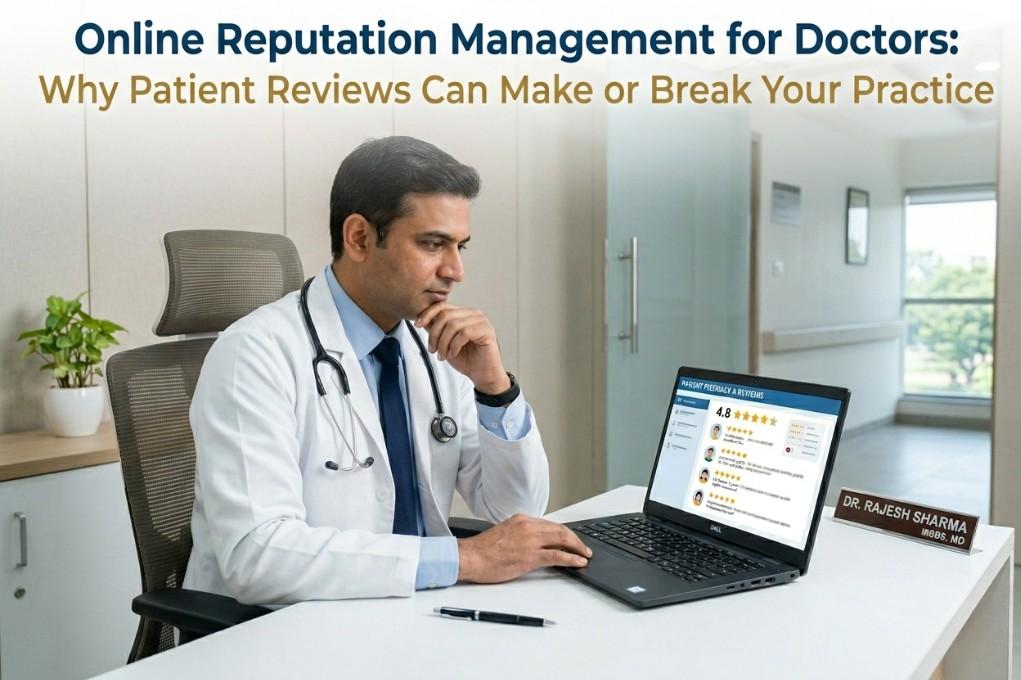
Before a patient books an appointment with your clinic or hospital, there is a strong likelihood they have already read what other patients have said about you online. In India’s increasingly connected healthcare landscape, a doctor’s digital reputation has become as influential as their clinical credentials in shaping a prospective patient’s decision. For this reason, online reputation management for doctors India is no longer an optional marketing consideration — it is a practice-critical priority.
A single unaddressed negative review on Google or Practo can deter dozens of potential patients. Conversely, a consistent pattern of thoughtful, genuine positive reviews builds a layer of trust that no paid advertisement can replicate. In Chennai and across Tamil Nadu, where healthcare options are plentiful and patients are growing more discerning by the year, your online reputation is often the first — and sometimes only — impression a new patient receives of your practice.
This article provides a comprehensive, actionable framework for understanding, building, and protecting your online reputation as a healthcare provider in India — covering review platforms, response strategies, compliance considerations, and the long-term role of ORM in sustainable practice growth.
The High Stakes of Online Reputation in Indian Healthcare
The shift in how Indian patients choose their healthcare providers has been both rapid and profound. A decade ago, doctor selection was largely determined by family recommendation and geographic proximity. Today, digital discovery plays a central role across urban and semi-urban India alike.
Research consistently indicates that a large majority of patients consult online reviews before selecting a doctor or hospital. On platforms such as Google, Practo, Justdial, and now increasingly on Instagram and YouTube, patients share detailed accounts of their experiences — from consultation quality and waiting times to staff behaviour and facility cleanliness. These reviews carry significant weight with prospective patients, often more so than any marketing message the hospital itself communicates.
For doctors and hospital administrators in Chennai, this creates a distinctive vulnerability. A specialist with fifteen years of clinical excellence can find their reputation undermined by a handful of negative reviews left by dissatisfied patients — regardless of whether the clinical outcome was appropriate. Meanwhile, a less experienced practitioner who actively manages their digital presence and maintains a strong review profile may consistently attract more new patients.
This asymmetry is not fair, but it is the reality of how digital reputation functions. The Indian healthcare market’s increasing competitiveness compounds this challenge further. With patients having access to more provider choices than ever — including telemedicine options that extend beyond geography — the margin for reputational vulnerability has narrowed considerably.
The response is not to fear online reviews, but to manage them proactively, ethically, and strategically.
A Strategic Framework for Online Reputation Management in Healthcare
- Audit Your Current Digital Reputation Across All Platforms
The first step in any ORM strategy is understanding exactly where your practice stands today. A comprehensive reputation audit covers:
- Google Business Profile rating and total review count
- Practo profile completeness, rating, and patient feedback
- Justdial listing accuracy and review sentiment
- Social media mentions on Facebook, Instagram, and YouTube
- Any news articles, forum discussions, or third-party content mentioning your name or hospital
This audit reveals not just your overall rating but the specific themes in patient feedback — recurring complaints about waiting times, praise for a particular consultant, concerns about billing clarity — that inform both your ORM strategy and your operational improvements.
- Optimize Every Review Platform Profile
An incomplete or inconsistent digital profile undermines trust before a patient even reads a single review. Every platform where your practice appears should display:
- Accurate and consistent clinic name, address, and contact information
- Current consultation hours for all departments
- Doctor credentials, qualifications, and years of experience
- High-quality photographs of the facility and clinical team
- A clear description of services offered, written in patient-friendly language
For hospitals in Chennai with multiple branches, this optimization must be completed separately for each location. Inconsistent information across platforms — a different phone number on Google versus Practo, for example — creates confusion and erodes confidence.
- Build a Systematic Process for Collecting Patient Reviews
The most common reason healthcare providers have too few reviews is not patient dissatisfaction — it is that satisfied patients are never asked. A patient who had an excellent experience is unlikely to leave a review unprompted. A patient with a complaint, however, often needs no prompting at all.
Correcting this imbalance requires a structured, ethical review collection process:
- Train front desk and nursing staff to politely request reviews from patients who express satisfaction at the point of discharge or consultation completion
- Send a WhatsApp or SMS follow-up message within 24 hours of the appointment, thanking the patient and including a direct link to your Google review page
- Include a review request in appointment confirmation and follow-up communications
- Display a QR code in the waiting area linking directly to your Google Business Profile review page
Crucially, review solicitation must never involve incentivizing patients with discounts, gifts, or preferential treatment in exchange for positive reviews. This practice violates both Google’s review policies and the ethical standards governing healthcare communication in India.
- Respond to Every Review — Positive and Negative
How a doctor or hospital responds to patient reviews communicates far more to prospective patients than the reviews themselves. A professional, empathetic response to a negative review demonstrates accountability and patient-centricity. Ignoring negative reviews communicates indifference.
For positive reviews, a brief, personalized acknowledgement — avoiding generic templated responses — reinforces the patient relationship and signals attentiveness.
For negative reviews, the response framework must navigate a critical compliance requirement: patient privacy. Under no circumstances should a response acknowledge, confirm, or discuss any clinical details of the patient’s treatment, even if the review contains clinical information. Doing so risks violating patient confidentiality.
An effective response to a negative review in the healthcare context:
- Acknowledges the patient’s experience without admitting fault or disclosing clinical details
- Expresses genuine concern for their dissatisfaction
- Invites them to contact the hospital directly to resolve the issue offline
- Maintains a calm, professional tone regardless of the review’s tone
This approach demonstrates to prospective patients reading the exchange that the hospital takes feedback seriously and handles concerns with maturity and care.
- Address Fake or Malicious Reviews Through Appropriate Channels
Fake reviews — whether from competitors, disgruntled former employees, or individuals with no genuine patient relationship — are a real problem for healthcare providers in India. The appropriate response is not to engage defensively in public, but to report the review through Google’s review management system with documented evidence of its illegitimacy.
For reviews that cannot be removed, a measured professional response that simply notes the hospital has no record of the reviewer as a patient is appropriate, while declining to speculate further.
- Build Positive Reputation Through Proactive Content and Presence
ORM is not solely reactive. The most durable online reputations are built through consistent, positive content that establishes a healthcare provider’s credibility across multiple digital touchpoints:
- Regular publication of medically accurate health education content on the hospital website and social media
- Doctor video introductions on YouTube and Instagram that humanize the clinical team
- Patient success story features — produced with full written consent and without making clinical outcome guarantees
- Active participation in health awareness campaigns aligned with national health days
- Earned media through community health camps and outreach initiatives that generate local press coverage
This body of positive digital content functions as a counterweight to any negative reviews that inevitably appear over time, ensuring that the overall picture patients find during their research is one of credibility, care, and community presence.
- Track Reputation Metrics and Respond to Trends
Effective ORM requires monitoring, not just management. Key metrics to track monthly include:
- Overall Google and Practo rating trends
- Total review volume growth across platforms
- Sentiment analysis of review themes — identifying recurring operational issues worth addressing
- Share of voice compared to key competitors in your specialty and geography
- Impact of review profile on appointment inquiry volume from digital channels
Tools such as Google Business Profile Insights, Practo’s provider dashboard, and third-party ORM platforms provide the data needed to track these metrics systematically.
What Proactive Reputation Management Delivers for Healthcare Practices
When online reputation management is approached strategically rather than reactively, the benefits for hospitals and clinics in India are substantial and compounding:
- A stronger review profile directly improves visibility in Google’s local search results, driving more organic appointment inquiries without additional advertising spend
- Higher average ratings reduce patient hesitation at the decision stage, increasing the conversion rate from online discovery to booked appointment
- Demonstrated responsiveness to patient feedback builds brand trust among prospective patients who read review exchanges before booking
- Early identification of recurring operational complaints — waiting times, billing communication, staff behaviour — provides actionable intelligence for service quality improvement
- Long-term reputational authority becomes a competitive moat that is difficult for newer or less attentive competitors to breach
The distinction between short-term and long-term ORM value is important: while an improved review profile can generate more inquiries within weeks, the real compounding benefit accumulates over years as a hospital builds an increasingly authoritative and trustworthy digital presence.
How Redwud Creations Manages Online Reputation for Healthcare Providers
Redwud Creations has built its ORM capability specifically around the unique demands of the healthcare sector in India. Managing a doctor’s or hospital’s online reputation requires a fundamentally different approach from ORM in retail or hospitality — one that balances patient privacy obligations, MCI advertising guidelines, and the emotional sensitivity inherent in healthcare experiences.
The agency conducts a full reputation audit at the start of every ORM engagement, mapping the client’s current standing across all relevant platforms, identifying the most urgent vulnerabilities, and establishing a baseline against which progress is measured. This audit informs a customized strategy covering profile optimization, review collection system design, response protocol development, and proactive content planning.
Redwud Creations’ team handles ongoing review monitoring and response management for hospital clients across Chennai and Tamil Nadu, ensuring that every patient review — on Google, Practo, Justdial, and social media — receives a timely, professionally crafted response that protects the hospital’s reputation while maintaining full patient privacy compliance.
The agency also integrates ORM with its broader healthcare digital marketing services, ensuring that a hospital’s improving review profile is amplified by parallel investments in local SEO, content marketing, and social media presence. This integrated approach produces faster and more durable reputational improvements than ORM pursued in isolation.
Monthly reputation reports give hospital administrators clear visibility into rating trends, review volume growth, sentiment patterns, and the ORM strategy’s measurable impact on appointment inquiry volumes.
Conclusion
Your online reputation as a doctor or hospital is not something that happens to you — it is something you can actively shape, protect, and leverage as a patient acquisition asset. In India’s competitive and digitally active healthcare market, the practices that manage their reputations proactively will consistently outperform those that leave their digital standing to chance.
The framework outlined in this article — from comprehensive audits and profile optimization to systematic review collection and compliant response management — provides a clear starting point for any healthcare provider serious about protecting and growing their practice through reputation excellence.
Redwud Creations is ready to be your ORM partner. Contact the team today for a complimentary reputation audit and take control of the digital impression your practice makes on every patient who searches for you online.