
Introduction
Redwud Creations works exclusively in healthcare. We’ve sat with marketing heads holding two or three agency proposals for a hospital website redesign, all promising a “modern, patient-friendly” site, with no real way to tell which one would actually turn visitors into booked appointments.
If you’re evaluating a hospital website design India project right now, you’re likely past debating whether your current site needs work — you’re deciding between design approaches, and possibly between agencies, without a clear standard to judge them against. Most proposals lead with visual mockups and brand aesthetics, which tells you almost nothing about whether the resulting site will convert. This guide gives hospital directors and marketing heads a practical way to evaluate competing approaches, based on what actually drives appointment conversion rather than design preference.
We’ll cover the difference between decorative and conversion-focused design, a framework for evaluating any proposal or agency against that standard, and what to prioritize if you’re rebuilding your hospital’s website in the near term.
Why Design Proposals Rarely Address What Matters
Most hospital website redesign proposals in India are evaluated on the wrong criteria — visual polish, homepage layout, colour palette — because that’s what’s easiest to compare across mockups. What rarely gets asked in the proposal stage is how the design will move a visitor from landing on the site to booking an appointment, which is the actual business outcome a hospital is paying for.
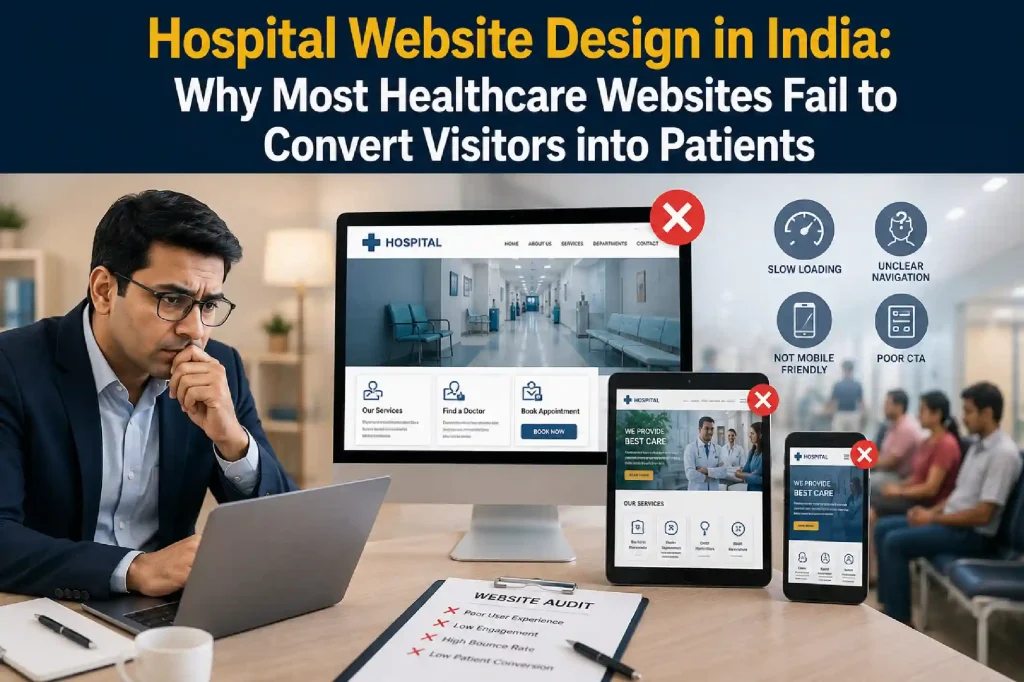
This gap has measurable cost. Industry benchmarks suggest most healthcare websites convert under 2% of visitors into leads, and a redesign that improves aesthetics without addressing conversion mechanics — time-to-contact, mobile load speed, booking flow friction — can leave that number essentially unchanged despite significant spend. For hospital directors evaluating proposals, this means the deciding factor shouldn’t be which mockup looks best, but which agency can demonstrate they’re solving for conversion specifically.
This matters for the marketing head’s credibility internally as much as for patient acquisition. A redesign that doesn’t move appointment numbers is difficult to justify to hospital leadership after the fact, whereas a proposal built around measurable conversion criteria gives marketing heads a defensible basis for the investment before it’s made.
A Framework for Evaluating Hospital Website Design Proposals
Most content on this topic offers generic UX advice without giving hospital decision-makers a concrete way to compare competing proposals or agencies. The framework below is built specifically for that evaluation.
Criterion 1: Does the Proposal Address Time-to-Contact? Ask any agency directly how their design gets a visitor to a contact action — call, WhatsApp, booking form — within seconds of landing, not just where the contact button sits visually. Agencies without a clear answer are likely designing for appearance, not conversion.
Criterion 2: Is the Site Architecture Built Around Symptoms or Departments? Compare whether the proposed structure organizes content by internal hospital departments or by how patients actually search — symptom and condition-specific pages that guide toward one specialist or action. The latter consistently outperforms generic department directories for conversion.
Criterion 3: Where Do Trust Signals Appear? Evaluate whether doctor credentials, testimonials, and accreditation appear near booking decision points, or are isolated on a separate About page most visitors never reach. This placement decision matters more for conversion than the credentials’ visual design.
Criterion 4: How Is the Booking Flow Designed? Request a walkthrough of the actual appointment form — how many fields, how much information required upfront. Every additional field reduces completion, particularly on mobile, and a proposal that hasn’t scrutinized this is missing a major conversion lever.
Criterion 5: Is Technical Performance Addressed Before or Alongside Visual Design? Ask whether page speed and mobile performance, particularly relevant given network conditions across tier-2 and tier-3 Indian cities, are being engineered as part of the design or treated as a post-launch afterthought. A beautiful, slow site will underperform a plainer, fast one.
Criterion 6: Does the Agency Measure Against Conversion, Not Just Launch? Ask how the agency proposes to measure success after launch — appointment requests, form completions, call tracking — versus simply delivering the site and moving on. This distinguishes a conversion-accountable partner from a purely design-execution vendor.
Channel and Compliance Considerations
A conversion-focused design should still support SEO for relevant long-tail queries like “healthcare website design that converts patients India,” and paid traffic should land on matched, specific pages rather than a generic homepage. All patient testimonials and doctor credential claims used in the design must comply with Medical Council of India (MCI) advertising guidelines, avoiding exaggerated outcome statements. Where international patient data is collected through the site, HIPAA considerations apply specifically to that flow, separate from domestic data handling.
Common Mistakes When Evaluating Proposals
The most common mistake is selecting an agency based primarily on visual mockups without asking any of the questions above, resulting in a polished site that doesn’t move appointment numbers. A second is failing to request post-launch measurement commitments, leaving no way to know whether the redesign actually worked.
What Hospitals Gain from Choosing the Right Approach
Hospitals that select a conversion-focused design approach typically see appointment requests increase from existing traffic without additional marketing spend, since the same visitors convert at a higher rate. This improves the return on every other channel feeding the site, from SEO to paid campaigns.
For marketing heads and directors, choosing correctly also creates internal credibility — a redesign with a measurable before-and-after conversion improvement is a stronger basis for future marketing investment than one judged purely on visual reception. Short-term gains show up in form and call volume; long-term gains show up in reduced overall patient acquisition cost.
How Redwud Creations Approaches This Evaluation
Redwud Creations builds every website proposal around the six evaluation criteria above, rather than leading with visual mockups. Our team combines healthcare marketing experience with conversion-focused UX practices specific to anxious, high-intent medical searchers.
Our methodology includes a conversion audit of the existing site before any redesign work begins, benchmarking current appointment request rates so improvement can actually be measured. We then design information architecture around symptoms and specialties, engineer for mobile page speed from the outset, and simplify booking flows, using GA4, PageSpeed Insights, and heatmap tracking to validate decisions against real visitor behaviour rather than design preference alone.
What differentiates our approach for hospital directors and marketing heads evaluating this space is that we commit to post-launch conversion measurement as part of the engagement, not an optional add-on discussed only if asked.
Not sure how your current site or a competing proposal would actually perform? Get a Hospital Website Conversion Audit to see where visitors are dropping off before you commit to a redesign.
Conclusion: Judge Proposals by Conversion, Not Just Design
Choosing a hospital website design approach in India shouldn’t come down to which mockup looks most polished. The right evaluation asks whether the proposed design addresses time-to-contact, patient-search-aligned architecture, trust signal placement, booking friction, and technical performance — the factors that actually determine whether visitors become patients.
If you’re currently comparing proposals or agencies for a hospital website redesign, running them through this criteria first will save budget and internal credibility later. Get a Healthcare SEO Audit from Redwud Creations to see where your current site or a proposed redesign stands before you commit.
FAQ
What should hospital directors ask when evaluating website redesign proposals?
Ask how the design addresses time-to-contact, whether site architecture is organized around patient symptoms rather than internal departments, where trust signals like credentials appear relative to booking points, and whether the agency commits to measuring conversion after launch, not just delivering a finished site.
Why do polished hospital website redesigns sometimes fail to increase patient bookings?
Redesigns often improve visual appeal without addressing conversion mechanics like booking form friction, mobile page speed, or trust signal placement near decision points. A visually strong site with these unresolved issues can leave appointment conversion essentially unchanged despite significant spend.
Should a hospital choose an agency based on design portfolio or conversion methodology?
Conversion methodology matters more for outcomes. A strong portfolio demonstrates aesthetic capability, but it doesn’t indicate whether the agency addresses booking flow optimization, technical performance, or post-launch measurement, all of which determine whether the redesign actually increases appointments.
How can hospitals measure whether a website redesign was successful?
Success should be measured against pre-redesign baseline metrics: appointment form completions, call tracking volume, and conversion rate from traffic to booked appointments. An agency unwilling to commit to measuring these post-launch is signaling a design-only, not conversion-accountable, engagement.
Is mobile performance really a major factor in hospital website conversion in India?
Yes. A large share of Indian healthcare searches happen on mobile, often on variable network conditions across tier-2 and tier-3 cities. Slow-loading mobile pages cause visitors to abandon before design quality even registers, making mobile speed a foundational conversion factor.