
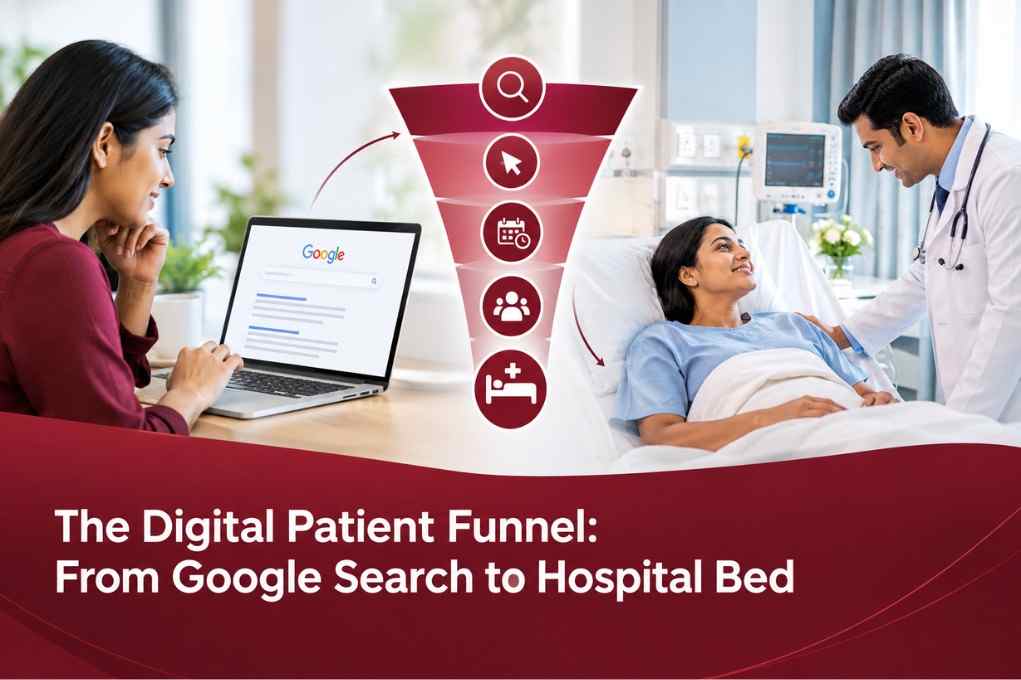
What Is a Digital Patient Funnel?
A digital patient funnel describes the sequence of stages a prospective patient moves through, from first discovering your hospital online to becoming an admitted patient. Unlike a simple traffic-to-lead model used in many industries, healthcare funnels involve additional trust-building and clinical decision-making stages, since patients are making a high-stakes decision about their health, not a low-consideration purchase.
Why Hospitals Optimize for Traffic But Not Conversion
Many hospital marketing teams invest heavily in generating website traffic, through SEO, paid ads, and social media, while investing comparatively little in what happens after a visitor lands on the site. This imbalance is understandable; traffic metrics are easy to measure and report, while conversion optimization requires deeper analysis of user behavior, website design, and follow-up processes. The result is often a hospital website that attracts substantial traffic but converts only a small fraction into actual patient inquiries, let alone admissions.
Mapping the Full Funnel: Search to Admission
A complete digital patient funnel for a hospital generally includes five key stages, each with its own drop-off risks and optimization opportunities.
Stage One: Discovery and Search Intent
This is where a prospective patient first encounters your hospital, typically through organic search, Google Maps, paid ads, or a referral link. Search intent varies significantly at this stage, some searchers are in urgent need of care, others are researching options for a future decision, and understanding this distinction shapes what content and messaging should greet them.
Stage Two: Website Evaluation and Trust-Building
Once a patient lands on your website, they’re evaluating whether your hospital feels credible, relevant to their specific need, and trustworthy enough to take the next step. This stage hinges heavily on clear specialty information, doctor credentials, patient testimonials or reviews, and a website experience that doesn’t feel outdated or difficult to navigate, particularly on mobile, since a significant share of healthcare searches happen on phones.
Stage Three: Inquiry and Lead Capture
This is the moment a patient decides to take action, calling, filling out a form, or messaging via WhatsApp. Friction here, confusing forms, unclear contact options, no immediate response mechanism, causes many otherwise interested patients to abandon before ever reaching a human conversation.
Stage Four: Follow-Up and Consultation Booking
Once an inquiry is captured, the speed and quality of follow-up significantly influences whether that lead converts into a booked consultation. Delayed responses, generic communication, or unclear next steps at this stage routinely cause hospitals to lose leads they’ve already paid to acquire.
Stage Five: In-Person Conversion and Admission
The final stage happens largely outside digital channels, the actual consultation experience, clarity of treatment communication, and administrative smoothness of the admission process. However, this stage is still part of the funnel because poor digital-to-in-person handoff, such as a patient arriving without their inquiry details properly communicated to the care team, can undermine conversion even after successful digital engagement.
Where Multi-Specialty Hospitals Typically Lose the Most Funnel Value
- Generic website messaging that doesn’t clearly differentiate between specialties, causing patients to struggle finding relevant information for their specific concern
- Slow or inconsistent lead follow-up, particularly for inquiries generated outside standard business hours
- Disconnected departments, where a lead expressing interest in one specialty isn’t properly routed or communicated internally
- Weak mobile website experience, despite mobile traffic often representing the majority of healthcare searches
- No structured tracking connecting digital leads to actual admission outcomes, making it difficult to identify where the funnel is genuinely leaking
Healthcare CRO: Practical Optimization Tactics by Stage
Funnel Stage | Common Leak | Optimization Tactic |
Discovery | Poor search visibility for specific specialties | Build specialty-specific landing pages with clear, relevant content |
Website Evaluation | Weak trust signals | Highlight doctor credentials, patient reviews, and clear specialty information prominently |
Inquiry Capture | Complicated forms, unclear contact options | Simplify forms, offer multiple contact channels including WhatsApp |
Follow-Up | Slow or inconsistent response | Implement structured follow-up protocols with defined response time targets |
Admission | Poor digital-to-in-person handoff | Ensure inquiry details are properly communicated to the care team before the visit |
Common Mistakes in Hospital Funnel Design
- Measuring success by traffic volume alone, without tracking downstream conversion to actual patients
- Treating the website as a static brochure rather than an active conversion tool
- Failing to differentiate funnel messaging by specialty, treating all patient journeys as identical
- Underinvesting in follow-up systems relative to lead generation spend
- Not closing the loop between marketing-generated leads and actual admission data, making funnel optimization guesswork rather than data-driven
A Framework for Mapping Your Own Patient Journey
- Document each stage a patient moves through, from first search to admission, specific to your hospital’s actual process
- Identify drop-off points using available analytics, form abandonment rates, lead response times, and consultation-to-admission ratios
- Prioritize the highest-leak stage first, rather than attempting to optimize everything simultaneously
- Test specific changes at that stage, such as form simplification or faster follow-up protocols, and measure impact
- Close the loop by connecting digital lead data with actual admission outcomes, so future optimization is based on real conversion data, not assumptions
Original Insight / Expert Framework
A pattern we consistently observe across hospital clients: leadership teams often assume their funnel problem is a traffic problem, when in reality, the far more expensive leak sits in the middle of the funnel, follow-up speed and quality, not the top. A hospital that improves its lead response time and follow-up consistency will often see conversion gains that dwarf what an equivalent increase in ad spend would produce, and at a fraction of the cost. Before increasing your marketing budget, it’s worth asking honestly: are we losing patients because not enough people find us, or because too many people who do find us never hear back quickly enough?
Key Takeaways
- A digital patient funnel spans discovery, website evaluation, inquiry capture, follow-up, and in-person admission, not just website traffic
- Most hospitals over-invest in generating traffic while under-investing in conversion optimization at later funnel stages
- Follow-up speed and consistency is often the single biggest lever for improving conversion, more impactful than additional ad spend in many cases
- Multi-specialty hospitals often lose funnel value due to generic messaging that doesn’t differentiate between specialties
- Closing the loop between digital leads and actual admission data is essential for genuine, data-driven funnel optimization
Frequently Asked Questions
How do I map the patient journey from search to admission?
Start by documenting each stage a patient moves through, from initial search to admission, specific to your hospital’s actual process, then use analytics to identify where drop-off is highest before prioritizing optimization efforts there.
What is hospital website conversion optimization?
It refers to improving specific elements of a hospital website, trust signals, form simplicity, page relevance, and mobile experience, to increase the percentage of visitors who take a meaningful next step, like submitting an inquiry.
How does a digital funnel work for multi-specialty hospitals?
Multi-specialty hospitals need distinct funnel paths for each specialty, since patients searching for different departments have different information needs and decision factors, generic, one-size-fits-all messaging tends to underperform.
What is healthcare CRO?
Healthcare CRO (conversion rate optimization) refers to systematically improving the percentage of website visitors or leads who convert into actual patients, through improvements at each stage of the digital funnel.
Why do hospitals lose patients after they've already generated a lead?
Common reasons include slow follow-up response times, inconsistent communication, and poor handoff between the digital inquiry and the in-person consultation experience.
Conclusion
The digital patient funnel for Indian hospitals extends well beyond website traffic, it spans discovery, trust-building, inquiry, follow-up, and the final in-person conversion to admission. Hospitals that treat this as a complete, mappable journey, rather than focusing narrowly on generating more clicks, consistently uncover far more valuable optimization opportunities than simply increasing ad spend ever could.
If your hospital generates solid website traffic but struggles to convert that interest into actual admissions, the answer likely lies somewhere in your funnel, not in your traffic volume. At Redwud Creations, we help hospital leadership map their complete digital patient funnel, identify exactly where value is being lost, and build practical strategies to close those gaps. Request a Patient Acquisition Strategy session today to see where your hospital’s funnel genuinely needs attention.