Introduction
Every healthcare event your institution hosts is a brand statement. Whether it is a national medical conference at a Chennai convention center, a continuing medical education session for referring doctors, or a free health camp in a residential neighborhood in Velachery — how that event looks, feels, and communicates defines how your institution is perceived long after the event ends. This is the strategic logic behind hospital event branding in Chennai, and it is one of the most underinvested areas in Indian healthcare marketing today.
Tamil Nadu’s healthcare institutions regularly host hundreds of events each year — specialty launches, patient awareness drives, CME programs, annual days, and community health initiatives. Yet the branding at many of these events is treated as an operational afterthought rather than a strategic opportunity. Generic banners, inconsistent visuals, and poorly designed collaterals send an unintended signal: that the institution treats its public presence casually.
This article outlines how Chennai’s hospitals and healthcare organizations can approach event branding strategically — covering medical conferences, CME programs, health camps, and institutional events — and why getting this right is central to long-term brand authority.
Why Healthcare Event Branding Is a Missed Opportunity
Healthcare events serve multiple audiences simultaneously. A medical conference draws specialists, general practitioners, medical students, industry partners, and media. A community health camp reaches patients, families, and local community leaders. A CME program connects hospitals with the referral networks that drive a significant portion of outpatient volumes. Each of these audiences forms impressions of your institution based not just on the clinical content of the event, but on the professional quality of its presentation.
The challenge is that most hospitals in Chennai approach events through an operations lens — venue booking, speaker coordination, logistics management — without a parallel brand strategy. The result is events that deliver clinical value but fail to build institutional equity.
This gap matters for measurable business reasons. Referral relationships — where general practitioners and specialists send patients to a particular hospital — are built substantially on trust and perceived institutional quality. A poorly branded CME event can undermine the very relationships the hospital is trying to strengthen. Conversely, a professionally executed event with cohesive branding, quality collaterals, and thoughtful post-event communication reinforces the message that your institution operates at a high standard across all its functions.
In Chennai’s competitive healthcare market, where institutions compete not just for patients but for clinical talent, insurance empanelments, and corporate health contracts, event branding is a competitive differentiator that many hospitals are leaving unused.
A Strategic Framework for Hospital Event Branding
Step 1: Define the Event’s Brand Objective Before the Design Brief
Every healthcare event should have a clearly defined brand objective that precedes any design work. This is distinct from the event’s clinical or operational objective. Common brand objectives for hospital events include positioning the institution as a thought leader in a specific specialty, strengthening referral relationships with the GP and specialist community, building community trust among a specific patient demographic, and announcing a new service, facility, or department to a professional audience.
The brand objective determines the visual language, tone of communication, and collateral strategy for the entire event. A tertiary care hospital launching a new robotic surgery program at a specialist conference requires a very different visual identity than a community hospital running a diabetes screening camp in an outer Chennai neighborhood. Treating both with the same generic template approach is a strategic failure.
Step 2: Build a Unified Event Visual Identity
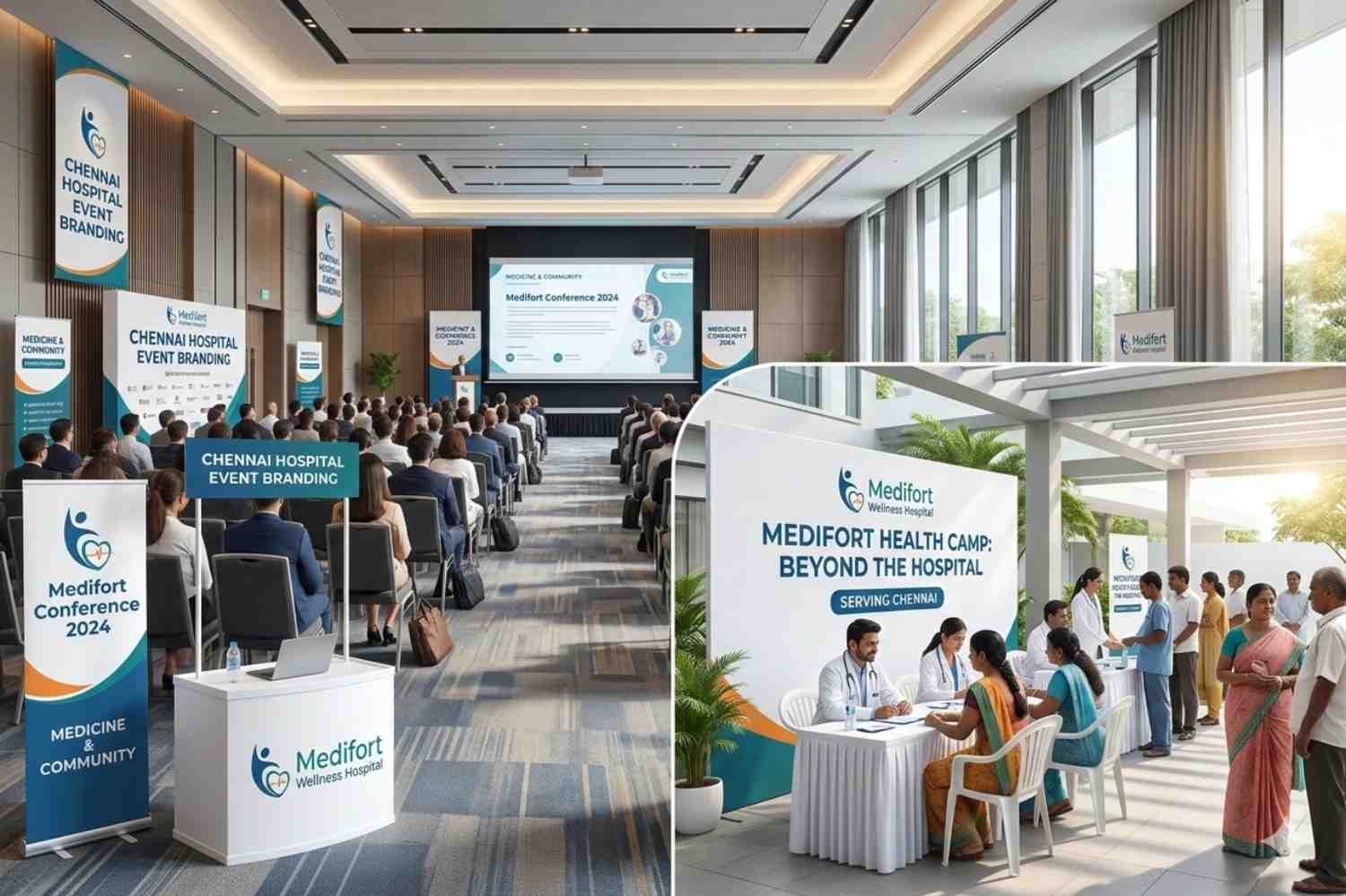
Once the brand objective is clear, the event requires a visual identity system — not just a banner and a flex board. A professional medical event branding approach includes:
- Event logo or title treatment aligned with the parent hospital brand
- Consistent color palette, typography, and graphic language across all event materials
- Stage and backdrop design for conferences and CME halls
- Registration desk and welcome area branding
- Directional and wayfinding signage within the event venue
- Speaker introduction panels and name boards
- Rollup standees, pull-up banners, and hanging displays
- Branded stationery: notepads, pens, folders, lanyards, and name badges
- Delegate kits and branded bags for conference participants
The principle here is visual consistency. Every element a delegate or patient encounters — from the invitation email to the event backdrop to the branded pen they take home — should reinforce the same institutional identity. This consistency is what converts a single event into a lasting brand impression.
Step 3: Develop Event-Specific Patient and Professional Communication Materials
Healthcare events often involve significant communication before, during, and after the event. Each of these touchpoints is a branding opportunity.
Pre-event communication includes email invitations, WhatsApp flyers, social media event graphics, event registration pages, and save-the-date cards. All of these should carry the event visual identity and the parent hospital brand. In Chennai’s healthcare market, WhatsApp remains the primary communication channel for doctor-to-doctor outreach — a well-designed digital flyer in a specialist WhatsApp group carries more institutional weight than many hospitals realize.
During the event, branding extends to presentation templates for speakers, patient education materials distributed at health camps, feedback forms, and live social media coverage. Hospitals that brief their event photography and videography partners on brand requirements — capturing specific backdrops, signage, and institutional visual elements — generate significantly more usable post-event content than those who do not.
Post-event communication — thank-you emailers, CME certificate design, event recap videos, and social media photo albums — extends the brand visibility of the event well beyond the day itself. A well-produced post-event reel from a medical conference, shared across the hospital’s Instagram and LinkedIn pages, reaches thousands of healthcare professionals and patients who were not present at the event.
Step 4: Approach Health Camp Branding with Community-Specific Sensitivity
Community health camps occupy a unique position in Chennai hospital marketing. They serve both a social responsibility function and a patient acquisition function — and the branding must navigate both with care.
Effective health camp branding in Tamil Nadu requires culturally sensitive visual communication, multilingual materials in both Tamil and English, clear service communication that sets accurate expectations about what screenings or consultations are available, and consistent institutional branding that builds recognition without feeling commercial in a community care context.
A common mistake is over-commercializing health camp branding — using aggressive promotional language or excessive logo placement in ways that feel inappropriate for a community service setting. The visual tone should be warm, accessible, and community-facing while still maintaining consistent institutional identity. Patients who receive a positive experience at a branded health camp are among the most likely to choose that hospital for their next significant healthcare need.
Step 5: Extend Event Branding into Digital Channels
Hospital event branding in the digital age cannot be contained within the physical event space. Every event should have a corresponding digital branding strategy that includes pre-event social media content, live event updates on Instagram Stories and LinkedIn, post-event content including photos, videos, and highlight reels, and Google Business Profile updates for event announcements.
For medical conferences and CME events, LinkedIn is particularly important. Healthcare professionals in Chennai are increasingly active on LinkedIn, and a well-documented institutional event — with speaker highlights, key takeaways, and professional photography — builds significant B2B brand authority in the medical community.
Compliance Considerations for Healthcare Event Marketing
All event branding and communication for healthcare institutions must remain compliant with MCI guidelines on medical advertising, which prohibit comparative claims, testimonial-based promotion, and certain patient outcome representations. Digital event promotion on platforms like Meta and Google also requires careful compliance management, particularly for events that touch clinical services. A professional medical event branding partner understands these constraints and builds compliant creative within them.
What Strategic Event Branding Delivers for Healthcare Institutions
When hospital events are branded with strategic intent and professional execution, the outcomes compound across multiple dimensions. Referral networks are strengthened through professionally executed CME events that signal institutional quality. Community trust is built through health camps that feel organized, caring, and well-resourced. Specialty authority is established through conferences that position your clinical teams as thought leaders. Patient acquisition improves as event participants — doctors and patients alike — develop stronger institutional preference based on direct brand experience.
Unlike digital advertising, which stops delivering the moment a campaign ends, well-executed event branding creates tangible physical and digital assets — photos, videos, collaterals, and relationships — that continue to deliver brand value long after the event concludes.
How Redwud Creations Approaches Hospital Event Branding in Chennai
Redwud Creations provides end-to-end medical event branding services for hospitals and healthcare institutions across Chennai and Tamil Nadu. Our approach treats every event as a brand-building opportunity — not a logistics exercise. We begin by understanding the event’s strategic objective and audience before developing a visual identity system and collateral plan that serves both.
Our event branding services span the complete spectrum: event identity design, stage and backdrop creation, collateral production, digital event assets, post-event content strategy, and social media amplification. We coordinate across design, production, and digital teams to ensure consistent brand expression from the invitation stage to the post-event recap.
We bring specific knowledge of Chennai’s healthcare event landscape — including the professional expectations of the South Indian medical community, the cultural sensitivities around community health camps, and the multilingual requirements of Tamil Nadu’s diverse patient population. Our team works closely with hospital communications and operations leads to ensure every event is executed smoothly and branded strategically.
We measure our success not just on event-day execution, but on the brand equity each event builds — tracked through post-event social reach, referral engagement, and the quality of institutional impression left with every attendee.
Conclusion
Healthcare events are among the most powerful brand-building tools available to Chennai’s hospitals and medical institutions — but only when approached with strategic intent and professional execution. From medical conferences to community health camps, every event is an opportunity to communicate institutional quality, build trust with clinical partners, and strengthen patient relationships.
If your hospital is planning an upcoming conference, CME program, specialty launch, or community health initiative and wants to ensure it reflects your institutional brand at the highest level, Redwud Creations is ready to help. Contact our Chennai team for a consultation on your next healthcare event branding project.