
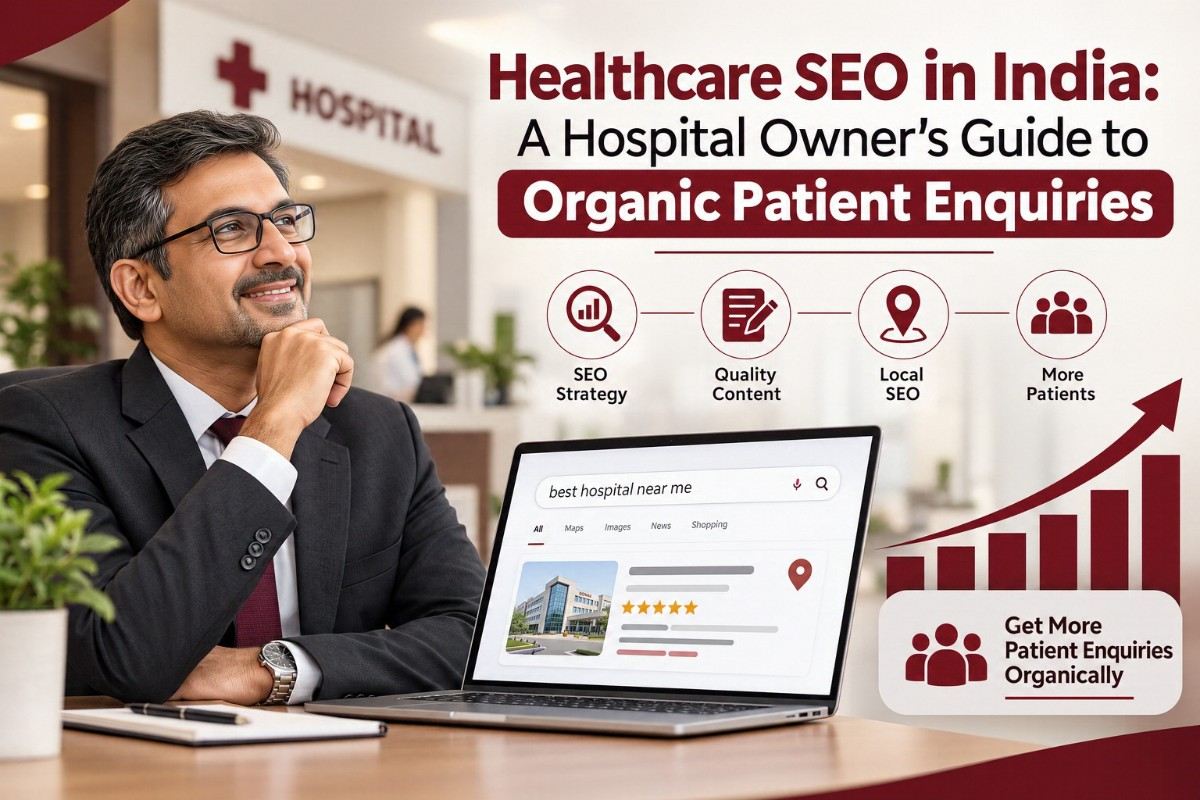
Most hospital owners we would expect to read this have already tried something. A website was built, a few paid campaigns were run, and an agency or a freelancer promised “first page on Google.” Yet enquiries from search still feel unpredictable, and it is hard to tell whether the spend is working.
This guide explains healthcare SEO India decision-makers can actually use: how organic search produces patient enquiries, what the work involves, how to judge a provider, what to measure, and which Indian regulatory points your team should review before publishing anything. It is written for the person who approves the budget and carries the accountability, not for patients.
What is healthcare SEO in India, and how does SEO work for hospitals?
Healthcare SEO is the work of making your hospital’s website and online profiles easily visible to the audience through search engines to find, understand and show when someone searches for a condition, a treatment, a specialist or a hospital nearby. It works by matching what patients type or speak into search with clear, accurate, well-organised pages and profiles that belong to your hospital.
Three terms are worth defining before going further.
- Organic search: unpaid results on a search page, as opposed to advertisements.
- Crawling and indexing: Google first discovers your pages (crawling) and then stores them so they can appear in results (indexing). A page that is not indexed cannot be shown.
- Local search: results tied to a place, such as “orthopaedic hospital near me,” which draw on your Google Business Profile as well as your website.
For a hospital, SEO is closer to infrastructure than to a campaign. Pages, profiles and reputation signals build up over time, and the same foundation supports every later marketing effort. Our healthcare SEO service covers this kind of work.
The four layers of hospital SEO
A useful way to review your own position is to separate hospital SEO into four layers. Weakness in any one layer limits the others.
Technical foundation
If Google cannot reliably crawl, load and understand your site, nothing else matters. Google’s own guidance on search features lists basics such as allowing crawling, making content findable through internal links and giving users a good page experience (Google Search Central, AI features and your website, 2025). For a hospital this means mobile speed, clean site structure, working appointment forms and no accidental blocking of important pages. A well-built website is the base for this layer, which is why healthcare website design and SEO are usually planned together.
Service and doctor pages
Patients search for specific needs: a procedure, a symptom, a specialty, a doctor. Hospitals often have one thin page for a whole department. Better practice is a dedicated page for each major service and each consultant, written accurately, reviewed by the clinician, and clear about what the patient should do next.
Local presence
For many hospitals most high-intent searches are local. Your Google Business Profile, consistent name, address and phone details across the web, and the reviews patients leave are all part of how you appear for local searches. Review handling needs care, and reputation management for healthcare is a related discipline to plan for.
Trust and content
Health is a sensitive subject, and quality matters more than volume. Content should be accurate, current, clinically reviewed and written for people. Author and reviewer details, last-updated dates and a clear way to contact the hospital all support trust.
Consider a hypothetical 80-bed multi-specialty hospital. It has one generic “Departments” page, an unclaimed or incomplete Google Business Profile, and no individual doctor pages. This is an illustration, not a real case. In that situation, the first priorities would likely be the profile, the service pages for its highest-value departments, and fixing any crawling problems. Blog content would come later.
How to get more patients from Google for a hospital: a sensible order of work
There is no single trick for this. There is a sequence that avoids wasted effort.
1. Audit before you build. Check whether key pages are indexed, how the site performs on mobile, whether your profile is complete, and what patients searching in your city and specialties currently see.
2. Choose the service lines that matter commercially. Not every department deserves equal effort. Decide with your leadership team which specialties, procedures or capacities you most want to fill.
3. Fix the foundation. Resolve technical issues and make sure appointment and enquiry paths work, including calls and WhatsApp.
4. Build or improve the priority pages. Service pages first, then doctor pages, then supporting content for the questions patients genuinely ask.
5. Strengthen local signals. Complete your profile, keep details consistent, and put a compliant process in place for handling reviews.
6. Measure, review and adjust each month. Decide what you will track before work begins (see the measurement section below).
How long does hospital SEO take?
No one can responsibly give a fixed date. SEO results depend on the starting condition of the site, the competition for your specialties and city, how quickly pages are published, and how often Google recrawls them. Google also states that meeting all best practices does not guarantee a page will be crawled, indexed or shown (Google Search Central, AI features and your website, 2025).
A more honest expectation is that early progress shows first in technical and indexing health and in local profile performance, and that growth in enquiries usually follows later and unevenly. Treat any provider who promises a specific ranking or timeline with caution.
How to choose a medical SEO company in India
If you are comparing a medical SEO company India providers or an in-house hire, ask questions that expose process rather than promises.
- What will you review first, and what will you show me from that review?
- How do you decide which pages to build or improve?
- Who writes and clinically reviews medical content?
- How do you handle the NMC advertising guidelines and patient data rules?
- What will you report each month, and can I see enquiries, not only rankings?
- What do you need from my team (doctor time, approvals, photos) and how long does that usually take?
- Who owns the website, profiles and accounts if we stop working together?
Be cautious of guaranteed rankings, secret methods, unexplained link buying, and reports that show only impressions or keyword positions.
On the in-house versus agency question, a small in-house team can manage day-to-day publishing and responses, while a specialist partner can supply strategy, technical work and reporting. Many hospitals use a mix. The right answer depends on your budget, authority and how quickly you need capability.
Compliance guardrails for hospital SEO in India
This section is general information. Your team should confirm requirements with your legal or compliance advisers.
NMC advertising and public communication guidelines
The National Medical Commission (NMC) is the regulator for medical practitioners. It issued Guidelines on Ethical Advertising and Public Communication by Hospitals/Medical Institutions and Registered Medical Practitioners through a public notice dated 6 October 2026, and reporting indicates they apply to hospitals and institutions as well as individual practitioners, across digital and traditional media (NMC public notice, 6 October 2026, as summarised by TeamLease RegTech, 2026).
In practical terms, hospital websites, service pages, review handling, social content and any use of AI-generated promotional material should be reviewed against the official text before publication. Press coverage suggests the guidelines address testimonials, misleading claims and AI use, but the exact provisions and how they apply to your pages should be read in the official notification, not in news summaries
Patient and enquiry data
Contact forms, call tracking, analytics and WhatsApp enquiries all involve personal data. The Digital Personal Data Protection Act, 2023 and the DPDP Rules, 2025 are being implemented in phases. Law-firm summaries state that the Rules were notified in November 2025, that provisions relating to the Data Protection Board took effect at notification, that Rule 4 on Consent Managers is due on 13 November 2026, and that most operational obligations are due on 13 May 2027 (Mondaq, 2026). As of this article’s date, the framework is therefore partly in force and partly pending. Hospitals should review their forms, notices and vendor arrangements with advisers now, rather than waiting for the later dates.
What AI search means for hospital SEO: confirmed and emerging
Many owners now ask whether AI answers have replaced SEO. The confirmed position, based on Google’s own documentation, is that Google states there are no extra requirements or special optimisations for appearing in AI Overviews and AI Mode, and that the same foundational SEO practices apply (Google Search Central, AI features and your website, 2025). Pages also need to be indexed and eligible to appear with a snippet.
What is still emerging includes how often AI tools cite hospital content, how patients’ behaviour is shifting toward conversational search, and which tactics, if any, influence citations on other AI platforms. These are not established ranking factors, and nobody can promise inclusion. A sensible response is to keep content clear, accurate and well structured, with direct answers to real patient questions, and to treat AI visibility as something to observe rather than guarantee.
Common mistakes and how to avoid them
- Buying SEO without fixing the website. Slow, poorly structured sites waste effort. Plan the foundation first.
- One page for everything. Create separate pages for major services and doctors.
- Ignoring the Google Business Profile. For local searches it matters as much as the site.
- Copying content from other hospitals or from AI tools without clinical review. This risks accuracy problems and unhelpful pages.
- Publishing claims, testimonials or comparisons without compliance review. Check against the NMC guidelines before going live.
- Measuring only rankings. Rankings do not pay bills; enquiries and bookings do.
- Treating SEO and paid ads as rivals. Paid search can give faster visibility while organic work builds, and healthcare PPC advertising and SEO can share landing page and keyword learning.
- Leaving ownership unclear. Make sure the hospital owns its domain, profile and analytics accounts.
How to measure healthcare SEO
Agree the measurement plan before work starts, and tie it to enquiries.
- Indexed pages and crawl errors: Google Search Console shows whether priority pages are indexed.
- Organic impressions and clicks by page group: Search Console, grouped by service line.
- Local profile actions: calls, direction requests and website clicks from the Google Business Profile.
- Organic enquiries: form submissions, calls and WhatsApp clicks attributed to organic search in analytics.
- Appointment conversions: enquiries that became bookings, tracked with the front office. This needs hospital-side data.
- Review volume and rating trend: tracked as a trust signal, handled in line with the guidelines above.
Expect gradual movement and some noise. Compare periods over months, and ask your provider to explain changes, including falls. Because there is no steady and sudden growth in SEO but it is sustainable and is standard that is different from your other options.
Where Redwud fits
Redwud Creations is a Chennai-based healthcare marketing firm offering digital and offline marketing services for doctors, medical practices, hospitals and diagnostic centres. Healthcare SEO sits alongside related services such as website design, paid advertising and reputation management, so organic work can be planned together with the rest of a hospital’s marketing. In general terms, the work begins with a review of the current website and profiles, then prioritises the specialties that matter most to the hospital, with reporting tied to enquiries.
Conclusion and key takeaways
Healthcare SEO is a long-term asset, not a quick campaign. Hospitals that treat it as infrastructure, with a sound website, specific service and doctor pages, a complete local presence and careful compliance review, are better placed to earn organic enquiries over time. Nobody can promise rankings or patient numbers, so judge providers on process, transparency and reporting.
Key takeaways:
- Review your foundation before spending on content.
- Prioritise the service lines that matter commercially.
- Measure enquiries and bookings, not only rankings.
- Review all public content against the NMC guidelines and your data practices with your advisers.
- Treat AI search as an area to observe, since Google says the same SEO fundamentals apply.
If you would like an outside view of where your hospital stands today, you can request a consultation with the Redwud team
Frequently Asked Questions
Yes, for local searches. It influences how your hospital appears for searches tied to a place, alongside your website. It should be managed as part of the same plan.
It depends on budget, speed and available skills. Many hospitals keep routine publishing in-house and use a specialist partner for strategy, technical work and reporting.
They serve different purposes. Paid search can bring visibility while spend continues, and organic work builds assets over time. Most hospitals benefit from planning both together.
This is a compliance question, not just a marketing one. Check the NMC guidelines of 6 October 2026 and consult your legal or compliance adviser before publishing any patient testimonial or review content.