
What Is an "Entity" in Search, and Why It Matters for Hospitals
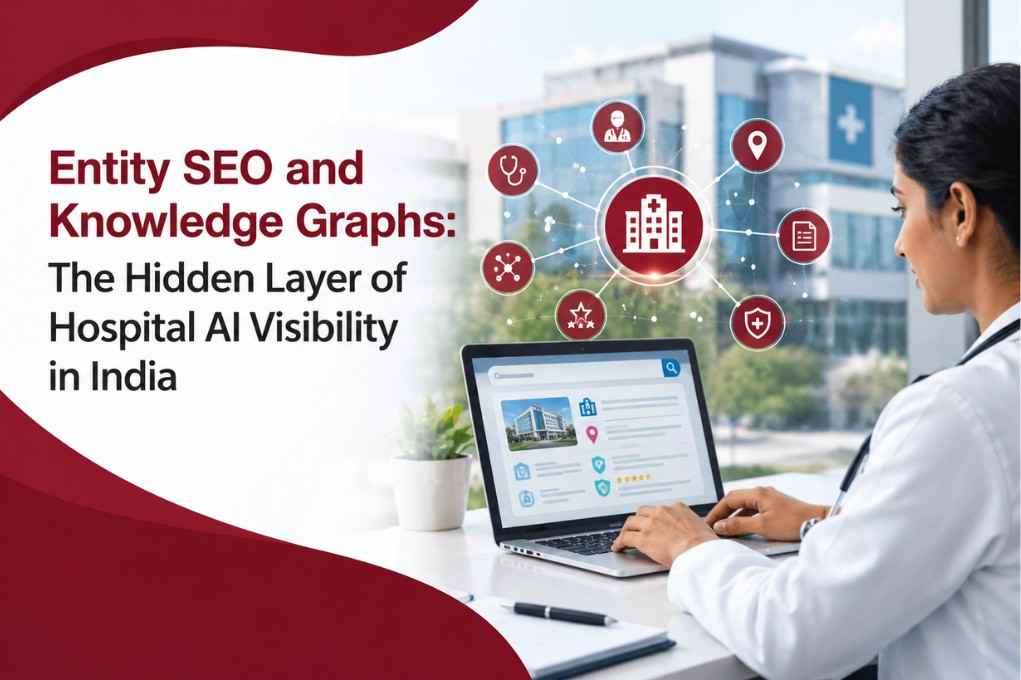
In search engine terminology, an “entity” is a distinct, identifiable thing — a person, place, organization, or concept — that a search engine or AI system can recognize and reason about independently of any single webpage. Your hospital is an entity. So is each doctor on your staff, each specialty department, each condition you treat, and each procedure you perform.
The critical shift to understand is this: search engines and AI systems increasingly don’t just index your web pages as isolated documents — they build an internal understanding of your hospital as a distinct entity, with defined relationships to other entities (your doctors, your location, your specialties, the conditions you treat). This entity-level understanding exists somewhat independently of your website’s content, drawing instead from patterns and consistency across the entire web.
This matters practically because a hospital can have well-optimized web pages and still have a weak or fragmented entity presence — meaning search engines and AI systems don’t have a clear, confident, unified understanding of who you are and what you do. That gap directly limits how confidently AI platforms can reference you in an answer.
What Is a Knowledge Graph?
A knowledge graph is a structured database of entities and the relationships between them, used by search engines like Google to organize and retrieve information more intelligently than simple keyword matching allows. Google’s Knowledge Graph, for example, is what powers the information panel that sometimes appears on the right side of a Google search results page — showing an organization’s name, logo, address, and key facts in a structured summary.
For a hospital, appearing clearly and accurately within relevant knowledge graphs means that when someone searches for your hospital, or asks an AI system about it, there’s a well-established, structured, verified body of information the system can draw on — rather than having to infer everything solely from your website’s prose content. This structured understanding of “who you are” is precisely the layer that many AI generative answers draw upon when deciding what to say about your hospital.
Entity SEO vs Traditional Keyword SEO
Factor | Traditional Keyword SEO | Entity SEO |
Primary focus | Ranking specific pages for specific search terms | Building a clear, consistent, structured identity for your hospital as a recognized entity |
Signals relied on | Keywords, backlinks, on-page optimization | Structured data, consistent NAP (name, address, phone) data, entity relationships, third-party validation |
Where the value lives | Individual web pages | The hospital’s overall digital footprint across the entire web |
Primary beneficiary | Search engine rankings | Search engines and AI systems’ underlying understanding of the hospital |
Timeframe to build | Can show results relatively quickly with focused effort | Builds gradually, since it depends on consistency and validation accumulating over time |
Neither approach replaces the other — a hospital still needs strong keyword-optimized content to rank and to be genuinely useful to patients. But entity SEO addresses a layer that keyword optimization alone doesn’t reach: whether search engines and AI systems have a clear, trustworthy, structured understanding of your hospital as a distinct, credible organization.
How Entities Power AI Search and Generative Answers
When an AI system generates an answer that references a hospital, it’s frequently drawing not just on the specific content of a webpage, but on its broader, entity-level understanding of that hospital — built from patterns across many sources over time. This is why:
- A hospital with a strong entity presence can be referenced accurately even when a user’s question doesn’t precisely match the wording of any single page on the hospital’s website
- Inconsistent entity information (a different hospital name spelling, an outdated address, conflicting specialty descriptions) can actively undermine an AI system’s confidence in referencing the hospital at all, even if individual web pages are well written
- Entities with well-established relationships — a hospital clearly linked to its doctors, its specialties, its location, and its accreditations — are easier for AI systems to reason about and confidently include in a synthesized answer
This is a meaningfully different mechanism from traditional page-level SEO, and it’s why a hospital can sometimes have strong website content yet still struggle with AI visibility — the entity-level foundation underneath the content may be fragmented or thin.
What a Strong Hospital Entity Actually Looks Like
A well-established hospital entity typically has:
- Consistent core information (name, address, phone number, specialties) that matches exactly across the hospital’s website, Google Business Profile, medical directories, and other listings
- Clear relationships to related entities — doctors linked clearly to the hospital and their specific specialties, departments linked to relevant conditions and procedures, and the hospital linked to its physical location
- Structured data implementation (schema markup) on the website that explicitly declares these entities and relationships in a machine-readable format
- External validation — mentions and consistent representation across independent, credible third-party sources, including recognized medical directories, health publications, and review platforms
- A Google Knowledge Panel or similar structured presence, reflecting that major search engines have already recognized the hospital as a well-defined entity
A hospital strong across all of these has a fundamentally more solid foundation for AI visibility than one relying purely on well-written but isolated web content.
Building Your Hospital's Knowledge Graph Presence
Practically, building a stronger knowledge graph presence involves sustained, coordinated effort across several fronts:
- Audit and unify your core entity information across every platform where your hospital appears — website, Google Business Profile, directories, social profiles, and any partner or referral listings
- Implement comprehensive schema markup, explicitly declaring your hospital, its doctors, its specialties, and its services in structured, machine-readable form
- Establish and maintain a Google Business Profile with complete, accurate, and regularly updated information
- Build genuine third-party presence through accurate listings on recognized medical directories and healthcare platforms relevant to India
- Create clear entity relationships within your own content — linking doctor profiles to their specialties, specialty pages to the conditions they treat, and location pages to the hospital’s overall identity
- Monitor your Knowledge Panel status (where applicable) and correct any inaccuracies that appear
This work compounds over time rather than delivering an immediate, one-time result — which is precisely why it’s often overlooked by teams focused on shorter-term marketing wins.
The Semantic SEO Checklist for Healthcare
Use this checklist as a starting point for assessing your hospital’s semantic and entity SEO foundation:
- Is your hospital’s name, address, and phone number identical across every platform where it appears?
- Does your website use schema markup to explicitly declare your hospital, doctors, and specialties?
- Are your doctors’ profile pages clearly linked to the hospital entity and their specific specialties?
- Does your hospital appear accurately on recognized medical directories relevant to India?
- Do your specialty pages use related medical terminology and synonyms naturally, rather than relying on a single keyword repeated throughout?
- Is your Google Business Profile complete, accurate, and regularly updated?
- Does a Google Knowledge Panel exist for your hospital, and is the information in it accurate?
- Are your specialty and condition pages linked to each other in a way that reflects genuine topical relationships (e.g., a cardiology page linking to related heart condition pages)?
Gaps in several of these areas typically indicate a fragmented entity presence — one of the more common, and more fixable, reasons a hospital underperforms in AI-generated answers despite having decent website content.
Common Entity SEO Mistakes Hospitals Make
- Treating entity consistency as a one-time setup rather than an ongoing discipline, allowing drift to creep in as directories change or new listings appear
- Skipping schema markup entirely, leaving search engines and AI systems to infer entity relationships without explicit structural signals
- Under-investing in doctor and department profile depth, which weakens the relationships between the hospital entity and the specific expertise it offers
- Ignoring third-party directory accuracy, assuming that owned website content alone is sufficient to establish a strong entity
- Confusing entity SEO with basic local SEO, when in reality entity SEO is broader — encompassing structured relationships across doctors, specialties, and conditions, not just location-based signals
Why This Is a Long-Term Authority Play, Not a Quick Fix
It’s worth being direct about this: entity SEO and knowledge graph building are not tactics that produce a dramatic visibility jump within a few weeks. They work by gradually establishing a consistent, well-validated, structurally clear identity across the web — a process that compounds in value over months, not days.
This is exactly why it tends to be overlooked by teams focused on shorter-term marketing metrics, and exactly why it represents a genuine differentiation opportunity. A hospital that commits to building this foundation now is building a form of digital authority that’s considerably harder for competitors to replicate quickly, unlike a single well-optimized landing page or an ad campaign.
Where Entity SEO Is Heading in Healthcare
As AI-powered search continues to mature, the weight placed on entity-level trust and structural clarity is likely to increase rather than diminish, since AI systems handling health-related queries face particular pressure to cite accurate, verifiable, well-established sources rather than isolated, unverified content. Hospitals that have already built a clear, consistent, well-validated entity presence are positioned to benefit disproportionately as this trend continues, while hospitals relying solely on page-level keyword optimization may find that foundation increasingly insufficient on its own.
FAQ
What is entity SEO for hospitals?
Entity SEO is the practice of building a clear, consistent, structured identity for your hospital as a recognized “entity” across the web — including your name, location, doctors, and specialties — so that search engines and AI systems can understand and trust who you are, independent of any single webpage.
How is entity SEO different from regular SEO?
Traditional SEO focuses on ranking individual web pages for specific keywords. Entity SEO focuses on your hospital’s overall digital identity and how consistently and clearly it’s represented and structurally connected across the entire web, which is a foundation that supports both traditional search and AI-generated answers.
What is a knowledge graph in the context of healthcare marketing?
A knowledge graph is a structured database of entities and their relationships, used by search engines like Google to organize information intelligently. A strong hospital knowledge graph presence means search engines have a clear, structured, verified understanding of your hospital, its doctors, and its specialties.
How do I build a hospital knowledge graph presence?
Key steps include unifying your core entity information across all platforms, implementing schema markup, maintaining an accurate Google Business Profile, building presence on recognized medical directories, and clearly linking related content (doctors, specialties, conditions) within your own website.
Does my hospital need a Google Knowledge Panel?
A Knowledge Panel reflects that Google has recognized your hospital as a well-established entity, and it provides a structured, credible summary of your hospital in search results. While not strictly mandatory, it’s a strong signal of entity authority worth working toward.
Conclusion
Most hospital marketing conversations stay at the surface — keywords, page rankings, ad spend. Entity SEO and knowledge graph presence sit a layer beneath that, in the structural, often invisible foundation that increasingly determines whether AI systems understand, trust, and confidently reference your hospital at all. It’s less immediately visible than a keyword ranking report, and it takes longer to build — which is exactly why hospitals that invest in it now are building a genuine, durable form of digital authority.
Redwud Creations works with hospitals to build this deeper technical foundation, not just surface-level content and keyword tactics, positioning healthcare brands for lasting visibility as AI search continues to mature.
Curious how strong — or fragmented — your hospital’s entity presence actually is across the web and within AI systems’ understanding? Get an AI Search Visibility Assessment from Redwud Creations, including a clear evaluation of your entity consistency, structured data, and knowledge graph foundation.